You understand how this release of SPR is not being sold ?
1 Like
Not personally, but he’s certainly free with giving away public assets instead of generating cash.
There’s a place for limited swap deals in the context of SPR releases, but it’s bad business to choose to “trade” all and not to sell any of it.
We were also spending like crazy at that point to keep the economy going.
I think we should have filled it but, as you noted, it was 90% there. A missed opportunity but can understand why someone would have thought spending may have been better elsewhere. It was a crazy time.
- The “Bonus” Return Mechanism: These releases are structured as swaps. Companies borrow crude immediately to address supply, but are required to return the barrels to the reserve later with a premium (e.g., roughly barrels returned for every borrowed).
Words of Caution from Wall Street
● Consensus estimates are calling for S&P 500 GAAP earnings growth of 32% in CY26, which would be the fastest since Q2 2022. Growth rates this high are normally reserved for the early days of economic expansions, when earnings are rebounding from de-pressed levels, not in year seven of an expansion.
● The only cases when GAAP EPS growth has exceeded 30% more than three years into an expansion were: Q2 1988 – Q1 1989 (post 1987 crash), Q2 1994 – Q2 1995 (heading into the internet productivity boom), & Q1 2000 (dotcom bubble peak).
● When year/year earnings growth has exceeded 20%, S&P 500 forward returns have been weak because investors anticipate that companies will not be able to maintain such rapid growth.
That kind of growth tends to come either at peak before a bust or coming out of a recession.
The question, I guess, is if AI makes this time different.
Agree.
The big question: Is Ai now like (1) the beginning of the internet in '95 or (2) the end of the dot.com boom in '00?
3 Likes
I’m taking advantage of rates and started laddering CDs. Since I have to take RMDs, it isn’t wise to be so loaded in equities, especially oil. Started selling oil stocks, XOM & PR. I want to buy back XOM at a lower price for the dividend. It needs to get much lower like 30+% lower
Hope to be at 50% or lower in equities by year end.
1 Like
Why not move those to tax free munis if facing RMDs ?
Of course someone will chime in you should have went to Roth to avoid
RMDs. Pay up front and done , but do face medicare penalty if you didn’t plan
ahead on the conversions.
My CDs are in a SEP. At 4%+ I’m getting more than a muni.
I remain sceptical of buying bonds with the lack of government control over the debt. You can lose money holding bonds. I’m becoming risk adverse as my arteries harden
2 Likes
2 Likes
Yep, you can see why there is such a huge push to get a deal with Iran asap.
2 Likes
The other thing about that is that it isn’t really a bright-line determination that can be avoided altogether. Hitting the point that he describes guarantees that oil prices will skyrocket, but the supply loss is already real, and it will continue impacting prices long after any deal with Iran. Until those reserve supplies are rebuilt, any market disruption will have a disproportionate impact on prices (as compared to prior to the war).
Something else to consider is that China has not been releasing its oil supplies into the open market, so they haven’t spent down like the rest of the world. That puts them in a powerful position.
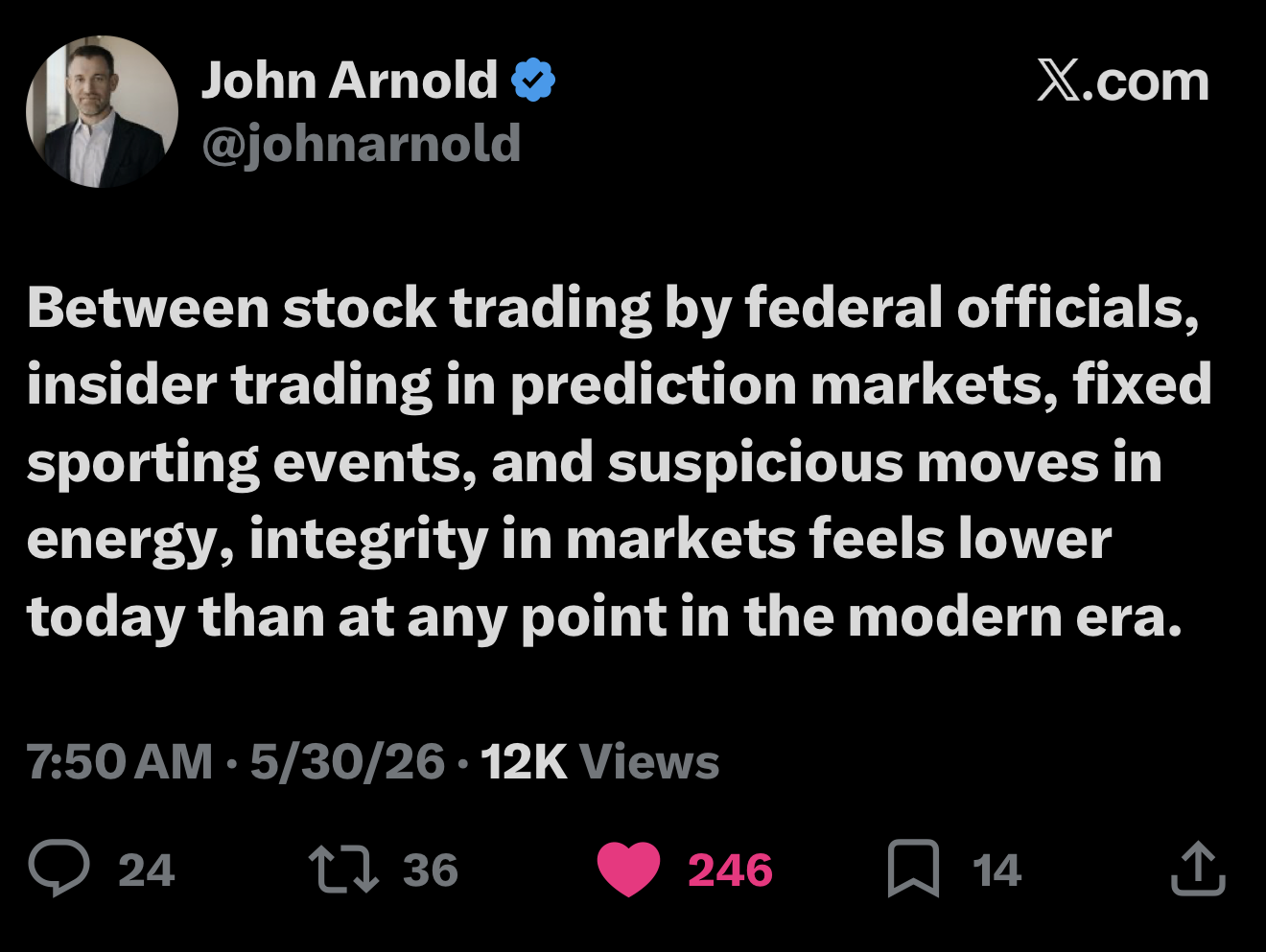
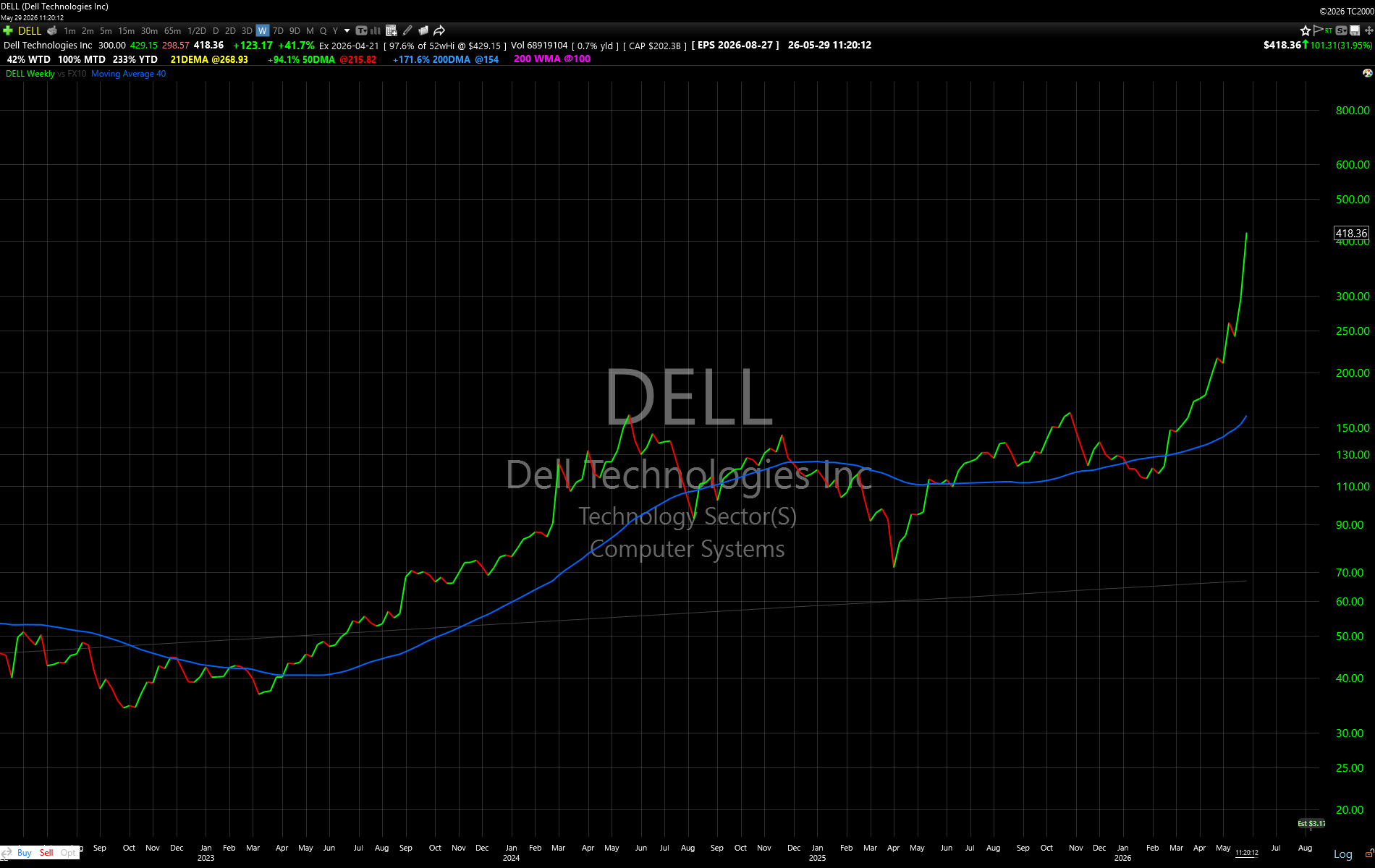
It’s beginning to smell a lot like 1929
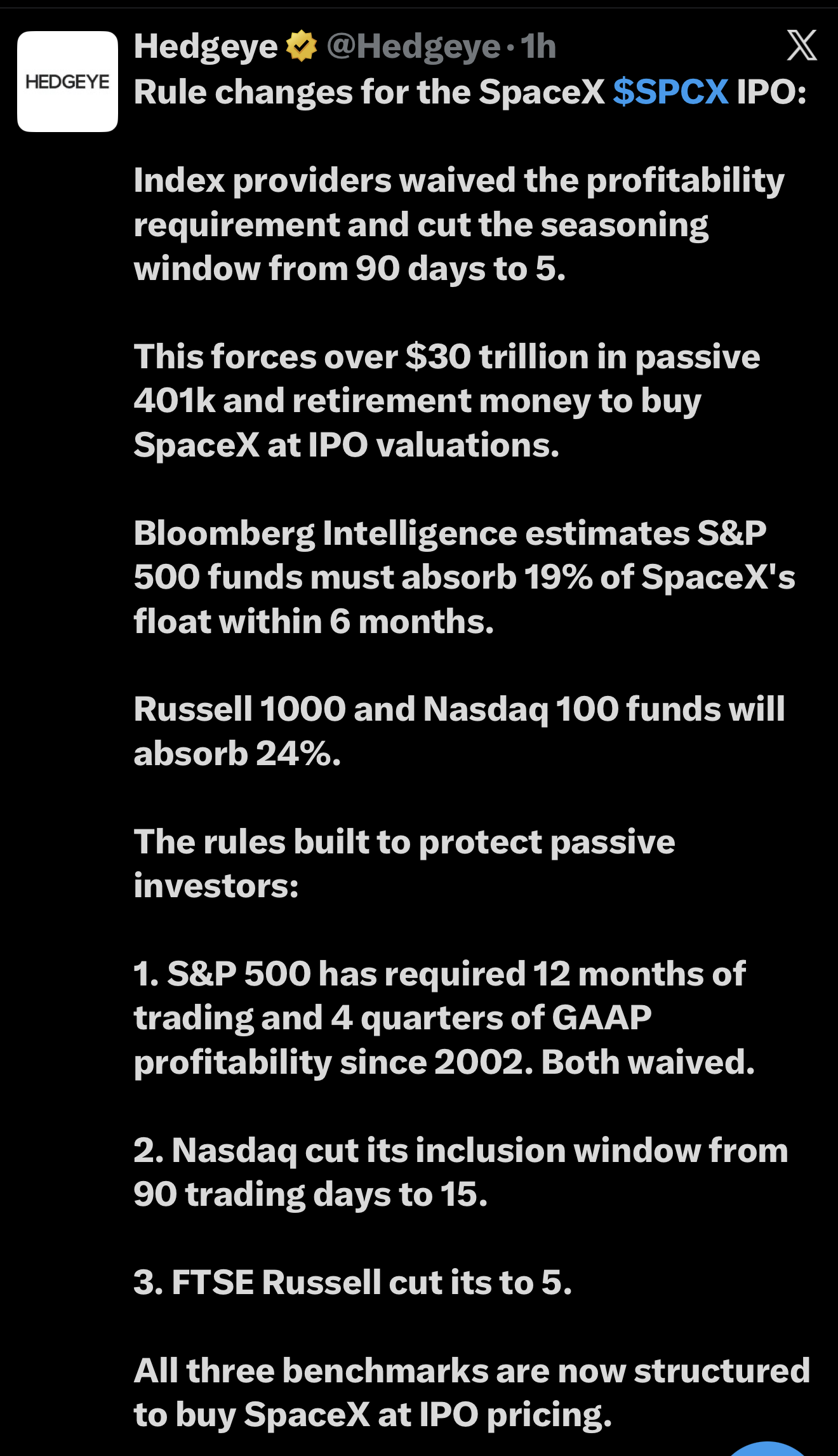
Update — I asked Grok about changes to S&P 500 Index inclusion rules and it looks the “SpaceX” changes are proposed but not implemented yet.
Grok —
S&P 500 MegaCap IPO Rule Changes (Proposed April 30, 2026)
-
Main proposals for very large companies (MegaCaps):
- Shorten IPO seasoning period from 12 months to 6 months of public trading before eligibility.
- Waive profitability requirement (no need for positive GAAP earnings over 4 quarters).
- Exempt MegaCaps from the minimum 0.10 Investable Weight Factor (IWF).
-
Why: To accommodate massive upcoming IPOs like SpaceX (and OpenAI/Anthropic) that don’t fit traditional rules.
-
Status: Consultation closed May 28, 2026. Possible implementation June 8, 2026 if approved.
-
Impact on SpaceX IPO:
- Targeting Nasdaq listing ~June 11–12, 2026 at ~$1.75–2T valuation.
- Under new rules: Eligible for S&P 500 consideration ~mid-December 2026 (vs. mid-2027 under old rules).
- Still requires S&P Index Committee approval; not automatic.
- Faster than current rules but slower than Nasdaq-100’s fast-entry (~15 days).
Other major indexes have already adopted quicker inclusion for large IPOs.
The SPR volume has now declined by over 50MM barrels in the last two months. Instead of selling them, the barrels have been given to domestic refiners and added to their stocks to be refined or sold.
The lost revenue from this arrangement is at least $5.5 BILLION so far. There’s an additional 122MM barrels still authorized for release, which will likely cost another $11 billion in lost revenues.
The stated plan is to return 200MM barrels to the SPR by October 2028 (election year), which would be a return of 16.3% in barrels.
If the admin is correct about oil prices crashing back to pre-war levels (they aren’t), then you would assume the prices in 2028 would be closer to $50-60/bbl. If they’re at $60 and we repurchased SPR oil at that price, it would cost about $10 billion out of the $16.5 billion sold to get back to even. A $6.5 billion profit would be a return of almost 40%.
You know who’s going to enjoy the difference? The oil companies who were gifted the SPR oil. Egregious.
2 Likes