Increasing playoff to 16 should ensure that we get 2 teams in playoff and not just 1. We NEED to get that increase approved.
The notable adjustment that I like is the power 4 conference champs get a guaranteed spot vs in the past of the 5 highest ranked conference champs. This way , we at least don’t lose our spot to a g5/6 where they might get 2 simply by going undefeated in a way easier conference.
So we have at least 1 guaranteed spot even in a lean yr for the big12.
16 is best.
Every Conf Champ gets a spot.
The 8 Highest Ranked Conf Champs get a 1st round home game, with the option to move it to a larger stadium nearby to increase attendance (revenue).
Round 2, the highest ranked teams remaining get another home game, with the same option for venue.
Use the top 3 Bowls (on a rotating / bid basis) for the Semis and the NC Game.
No “guaranteed slots for ANY Conference or Independent, unless they Win their Conf.
Might force ND to join a Conf?
The SEC and B1G would never go for this, but it would certainly shake things up.
IMO, it’ll be 24 teams by 2030, if not sooner.
Every FBS Team should be able to control their own destiny and have a “shot” at a National Championship, every year…
2 Likes
Talking about PUF, this is the exact reason UH alumni need to take control of more seats in the legislature, went ahead and ran some numbers regarding the Texas state senate and congress in relation to a congressmen’s university affiliation and found striking numbers:
Texas State Congress:
| Column 1 | Column 2 | Column 3 |
|---|---|---|
| University of Texas at Austin | 23 | Anchía, Cole, Cortez, Flores, Gámez, Gerdes, Hinojosa, Howard, Johnson, Jolanda Jones, Little, Longoria, Martinez Fischer, Moody, Eddie Morales, Muñoz, Phelan, Rosenthal, Slawson, Spiller, Talarico, Troxclair, Vasut |
| Texas A&M University | 17 | Ashby, Bonnen, Buckley, Frank, Harrison, Hickland, Isaac, Venton Jones, Landgraf, Lozano, Oliverson, Orr, Patterson, Richardson, Schoolcraft, Vasut, Wu |
| University of Houston | 8 | Allen, Cain, Collier, Hull, Morales Shaw, Vo, Walle, Ward Johnson |
| Texas Tech University | 5 | Burrows, Craddick, Moody, Smithee, Villalobos |
| Texas Southern University | 5 | Allen, Bowers, Collier, Meza, Reynolds |
| Southern Methodist University (SMU) | 5 | Anchía, Bhojani, Bryant, Geren, Hunter |
| St. Mary’s University | 5 | Canales, Hayes, Landgraf, LaHood, Spiller |
| Sam Houston State University | 4 | Burrows, Luther, Metcalf, Morgan |
| University of North Texas | 3 | Hopper, Kerwin, Plesa |
| University of Texas at Dallas | 3 | Bhojani, Button, Pierson |
| Baylor University | 3 | Hickland, Leach, Oliverson |
| UT San Antonio | 2 | Cortez, Martinez Fischer |
| Texas Christian University | 2 | Hayes, Wharton |
| Lamar University | 1 | Manuel |
| UT Rio Grande Valley / Pan American | 1 | Janie Lopez |
| Stephen F. Austin State University | 1 | Cook |
| Abilene Christian University | 1 | Lambert |
| Texas Woman’s University | 1 | Bumgarner |
| Harvard University | 1 | Talarico |
| Georgetown University | 1 | Vincent Perez |
| Spelman College | 1 | Bowers |
| New Saint Andrews College | 1 | Alders |
| Tulane University | 1 | Anchía |
| University of Michigan | 1 | Bernal |
| Ohio University | 1 | Hopper |
| University of Arizona | 2 | Ward Johnson, Zwiener |
| Bellevue University | 1 | Tinderholt |
| University of Karachi (Intl) | 1 | Lalani |
Texas State Senate:
| Column 1 | Column 2 | Column 3 |
|---|---|---|
| University of Texas at Austin | 10 | Cook, Creighton, Eckhardt, Johnson, Middleton, Schwertner, Sparks, Zaffirini (Law: Middleton, West) |
| Baylor University | 3 | Hancock, Hughes (Law), Paxton |
| Texas A&M University | 2 | Bettencourt, Flores |
| University of Houston | 2 | Alvarado, West (Law) |
| Texas Tech University | 2 | Campbell, Perry |
| Lamar University | 2 | Birdwell, Nichols |
| Southern Methodist University | 1 | Menéndez |
| Texas Christian University | 1 | Kolkhorst |
| UT San Antonio | 1 | Gutierrez |
| UT Pan American (UTRGV) | 1 | J. Hinojosa |
| UT El Paso | 1 | Blanco |
| Sam Houston State University | 1 | Miles |
| UT Arlington | 1 | West |
| Dallas Baptist University | 1 | King |
| University of Dallas | 1 | Parker |
| U.S. Naval Academy | 1 | Hagenbuch |
| The Citadel | 1 | Hall |
| Georgetown University | 1 | J. Hinojosa |
| Johns Hopkins University | 1 | Cook |
| New York University | 1 | Eckhardt |
| Louisiana State University | 1 | Huffman |
| London School of Economics | 1 | Parker |
| Stanford University | 1 | Hagenbuch |
| University of Maryland, BC | 1 | Patrick |
| University of Arizona | 1 | Johnson |
Simply put, the universities who have bulk access to the PUF have larger contingent. This makes passing legislation that benefits other schools besides UT and TAMU provocatively difficult, proving even something like the TUF difficult to pass.
4 Likes
I see you completed your homework assignment. Nice job. Philosophically, I am with you. We have a long way to go…and we are on our own 5 yard line. I don’t see this getting done in the next 25 years.
Celebrate TUF and call it a day.
1 Like
The TUF was a great get, but the PUF should’ve never been excluded in the first place. Love the commitment from Texas though, especially with the annual $100 million investment into the fund.
The TUF should grow dramatically in the coming decades:
- You have a 100$ million annual contribution
- $3.9 billion initial investment
- UH claims $1.35 billion of that. - A conservative 5% growth rate after payouts gets you ~$6.25 billion ($2.2 billion UH) a year 10, and ~$10 billion ($3.6 billion UH) at year 20.
- This means payouts equal Year 0: $60 million, Year 10: $100 million, Year 20: $170 million. Which is a rather large step up from where UH was before.
We could see UH’s combined endowment reach $5 billion in 10, and $8 billion in 20 years.
4 Likes
Never, never should we stop to demand for UH and all other public universities to have access to the PUF.
It is an insult to all public universities and every Texan that they do not have access to the PUF.
Having access to the TUF is this:

Having access to the PUF is equal to:

The only reason that we do not have access to the PUF is due to the following. ut system politicians are controlling and blocking any efforts for the PUF to be expanded. These same politicians could care less about education. If they did they would expand the PUF. Expanding the PUF would be the biggest education improvement to Texas, for Texans. The other question has to be asked. Who, which individuals besides the ut system benefits from the PUF? That is something every Texan ought to know.
3 Likes
TeeTee’s evaporation was painful to watch and reflected badly on the Big 12.
Typical TeeTech, can’t get up when it matters
I do like the 24 team playoff. UH could be in it every year.
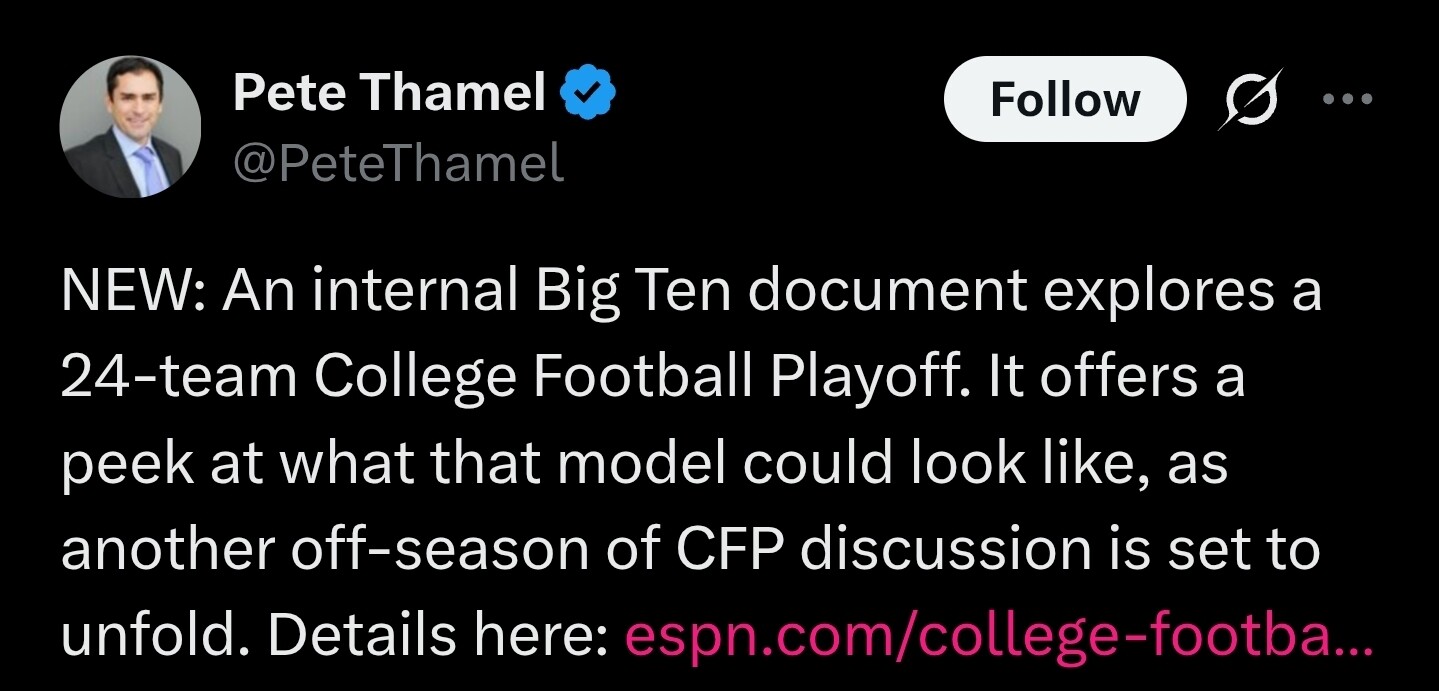
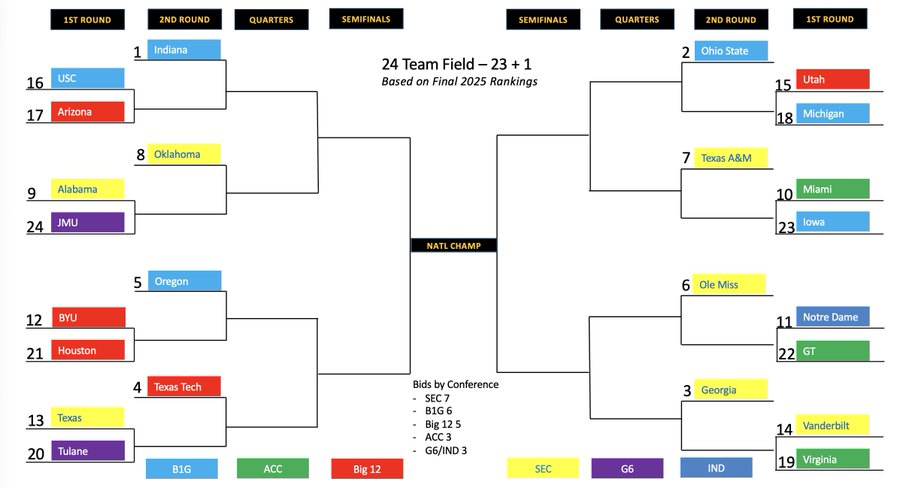
(According to the document, the breakdown for this field if it had played out in 2025 would have been seven SEC teams, six Big Ten, five Big 12, three ACC, two Group of 6 and Notre Dame.)
3 Likes
Big 12 gets 5 teams in the 24 team playoff…wow…
3 Likes
That is why the sec is against this.
It is not about sports but about money.
1 Like
Given how lopsided conferences are, if this is the playoff format and you’re a Bama or an Ohio State or a Notre Dame, why would you watch the regular season? This feels like it’s trying to turn Football into College Basketball, but nobody watches regular-season College Basketball.
How so? You still have to be outstanding. I would love that format.
The nfl has wild cards. People watch their franchise.
Outstanding is a bit of a stretch. Iowa would have gotten in this year, and they were 8-4 with their best win coming against a 7-5 team. 2022 Texas would have made the playoffs at 8-4, too.
2016 UH would have gotten in, and that team was spiraling by the end of the season.
At 24 teams, you’re entertaining the possibility that an 8-4 LSU or Florida or Alabama team can go winless on the road and still make the playoff. You’re letting in P4 teams that barely went .500 in conference, and even that might have been due to a soft conference schedule. That’s not a great season.
The NFL is different; first, there’s WAY more parity, and second, schedules are structured to keep the playoff race mostly competitive. If a team in your division is clearly better than you, they get two head-to-head wins and it’s significantly harder to make the playoffs even as a wildcard, and teams that win the division are given a harder schedule. College football does none of that.
1 Like
Indiana that was always considered a doormat is now National Champion. Parity is now closer to college football than ever. We had Indiana vs Miami in the cfp final. Just a season ago nobody would have thought either team would be making the cfp and surely not the cfp final. The nil is the great equalizer. What it is doing is putting all FBS DIV I teams on an even playing field. Technically you can get a major donor and again with an outstanding HC and coaching staff and make it to the cfp and get a chance to win it. The point of blue blood that have cheated for decades is what nobody wants to talk about. Now everybody is playing in the same sand box.
1 Like
Not really. It is putting B1G tams on equal footing and SEC teams on equal footing within their conferences. Tech in the Big 12.
It is not helping G schools. They are falling further back as the P schools can still buy away their top players. Pre-NIL you had Utah, TCU (MWC, Boise (WAC), and UH (American) all winning big bowl games. Now the G schools are just getting blown out with Tulane and JMU this year and Boise last year.
It is creating a bigger divide within the FBS.
1 Like
I want somebody to wake me up whenever some team other than a full shares B1G member wins it all.
It takes one mega donor, just one.
Hasn’t helped a G-league team, nor has it enabled any team except teams from the richest conference (B1G) to win it all in the last three years.
Rich getting richer.