It’s not me. It’s what I’ve read in this thread. This thing was gonna go quickly, then slowly, and so forth.
1 Like
Seriously. People were going on about how they were on the verge of collapse in May and that the blockade would finish them off in short order.
1 Like
You guys understand hitting a bunch of power plants would finish them off at any time and they don’t have an air defense right? And that’s been an option for a long time?
I’m glad they haven’t because there isn’t a quick fix to that and they are near a humanitarian crisis already.
1 Like
That doesn’t change anything I said.
Didn’t we already do that and just new people took over?
(assuming “they” is Iran)
They never had control of it. The Strait of Hormuz is an international waterway. Always has been. The US gave them the motivation to do what they’re doing right now. We helped them prove its possible to restrict, if not completely control, traffic, giving them a negotiating power they never had before. They may never see it differently now.
3 Likes
They’ve been 2 weeks away for 20 years even after being annihilated twice. Go figure.
1 Like
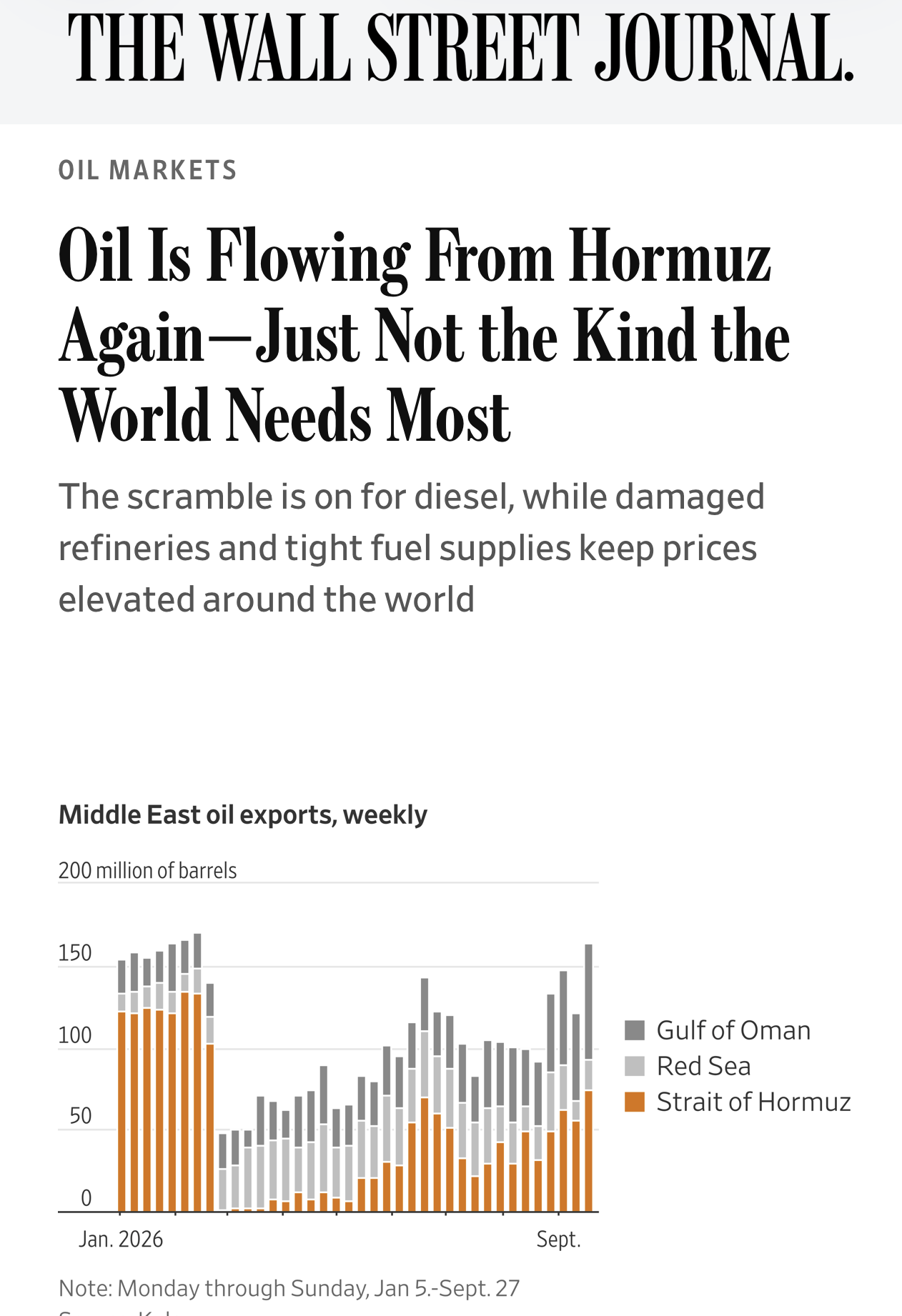
It makes you wonder why the US is trying to release 40MM more barrels from the SPR now. Without solving the refining problem, all this will do is increase trading and refining margins.
At some point, this drawdown of oil reserves has to stop, and rebuilding inventories has to start. That’s gonna keep oil prices high for a while.
This seems to have turned again.
Oil prices climbed Thursday on continued worries about global supply following a record number of tanker attacks that sent crossings through the Strait of Hormuz to a two-month low.
Brent crude, the global oil benchmark, rose 4.3% to $104.48 a barrel early on Thursday. West Texas Intermediate, the US benchmark, increased by a similar margin to $92.05 a barrel.
Just seven tankers transited the Strait of Hormuz on Tuesday, less than half the seven-day average and the lowest number since July 23, Kpler data showed. There have been a record number of attacks on commercial vessels, with 10 tankers struck in the strait between September 28 and October 4, well above the previous weekly high of six, Kpler said in a report Thursday.
1 Like
“Just seven tankers transited the Strait of Hormuz on Tuesday, less than half the seven-day average and the lowest number since July 23, Kpler data showed.”
So, the 7 day avg was only 14 and now its down to 7. Yet, folks here are still calling it “open” like everything is fine.

2 Likes
It’s all under control.
And if it isn’t, it doesn’t matter anyway.

2 Likes
So that doesn’t include plain cargo, just tankers but still. Google AI search said it was around 125 large cargo ships (including tankers) a day before the war.
1 Like

More life I. Iran, it’s crazy but it doesn’t look close to collapse, struggles are very real and young people
aren’t happy. But you can say the same thing about America
Welcome home to the USS Lincoln.
1 Like
@Kyle_Be_Coogin, did you greet the Lincoln? Give us a short (or long) opinion on a 10-month deployment, if you would, please; it doesn’t have to be political. Full disclosure, I never served on a float, so I can’t really opine on whether that is excessive or not. My year in Okinawa did seem like 2 years, though, but I learned to snorkel in the most beautiful waters I had ever seen in my 19- to 20-year-old life.
I’d be interested in that too. I honestly have not ever discussed with anyone what it is like to serve afloat. Would be interesting to learn more.
I did 366 days in theater during my first Afghanistan tour, and 300 days in my second, so to me, 10 months doesn’t seem that long.
I guess I wasn’t afloat though.
1 Like
My cousin did a couple of carrier and submarine tours, and they were typically 6 months, though that included several port stops. The longest one without a stop was about 3 months, and she said that was tough from a “togetherness” standpoint and resulted in some mental health episodes.
1 Like