I have no clue how good, or bad, UNT will be this year since the strength of their team now plays for Okie State. I’m glad we play the Cowboys at TDECU, I think they may be our toughest opponent after TT. Maybe even more than TT, we will see. We may meet BYU in the CCG.
Okie State plays Oregon for their 2nd game at Stillwater; a chance to make a big statement for the B12, BYU also plays Notre Dame with another chance for the B12 to make a big statement.
Not that odd; the networks tend to try to give all the CCGs their own timeslot. IIRC the PAC-12 and ACC championship games have been played in Thursdays/Fridays a lot.
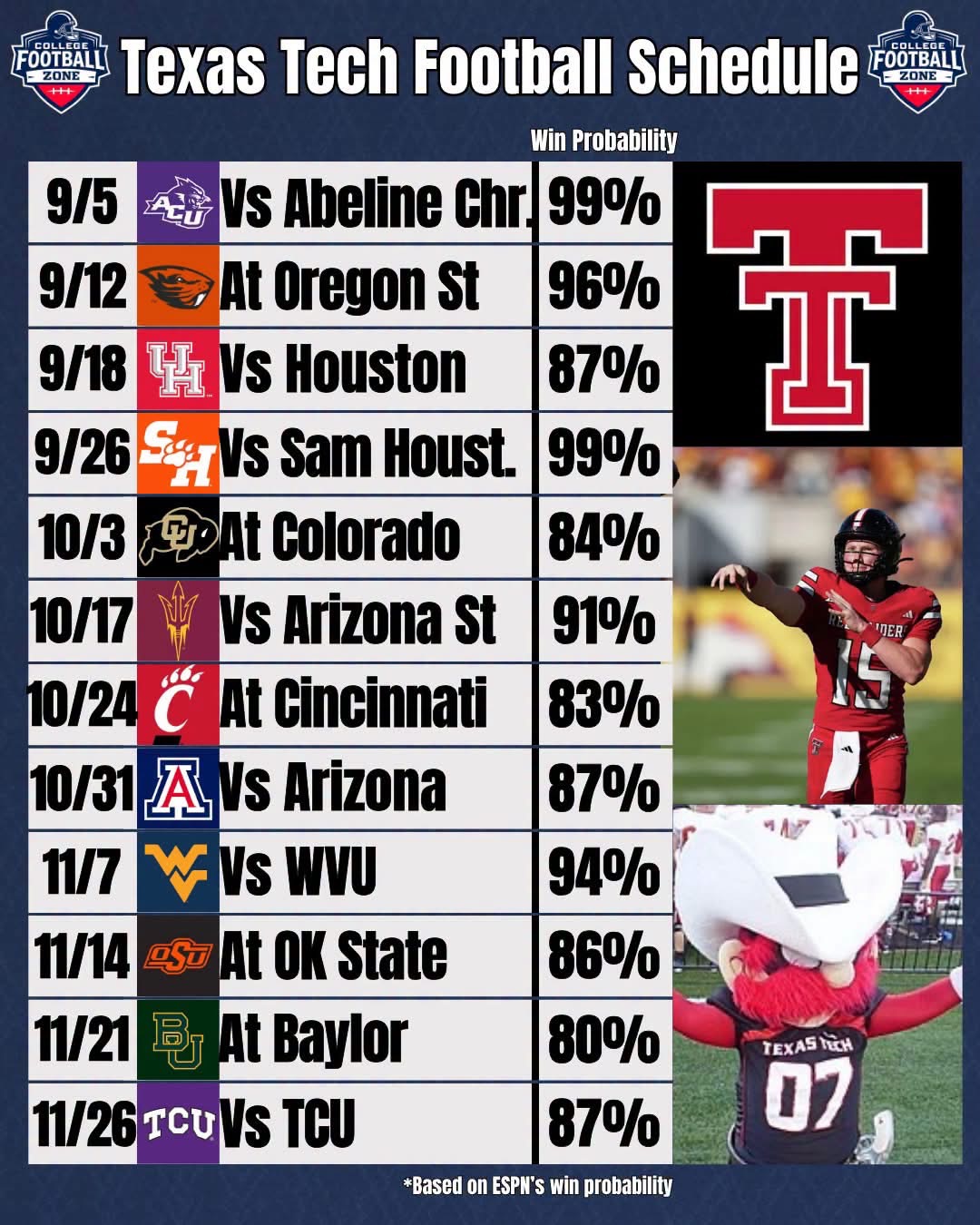
No one should be surprised that the Raiders are favored in every game. They have beaten us 7 times in a row and we play them in Lubbock. Winning there would be quite an accomplishment.
Bet your arse beatin’ em in Lubbock is a tall order. Figger, after the dust storm, what else is there to do? Crank up the blower, get the foot of dust off the pickup, pull the cord with ticket tied to it, under that foot of dust. Of course all the other dust mites will be there -from 500 miles around!!!
The English phrase “get off the schneid” originates from German card games. “Schneid” is a clipping of “Schneider,” the German word for “tailor.” In the game of skat, a player scoring thirty or fewer points is said to be “im Schneider,” or “in the tailor.” The idiom “aus dem Schneider sein” means “to be out of the tailor,” or to have scored more than thirty points. This terminology passed into gin rummy, where “schneider” or “schneid” referred to a shutout, or failing to score any points.
In American sports slang, particularly baseball, it came to mean a losing or scoreless streak. To “get off the schneid” means to break that streak by finally scoring or winning.
ESPN announcer Chris Berman helped popularize the phrase in the nineteen-eighties and nineties.
FWIW, as noted in the bottom, these numbers are from ESPN’s FPI, and imply about a 25% chance of going undefeated. And it does in fact indicate that Baylor is the toughest game on their schedule, although it seems to be weighting home field advantage pretty heavily in that calculation.
FPI also just isn’t that good. Most other preseason predictions beat it out, including stuff like preseason media polls. I’ve noted in the past that it tends to be extremely sticky, too — Penn State, for example, finished last year at #16, one spot behind Oklahoma, which is pretty hard to justify by looking at their respective resumes. I’m not necessarily saying that FPI is a load of BS designed with the express intention of giving ESPN “analytics” to support a narrative that they wanted to push, but, well, if that were the intention, FPI would be doing a really good job of it.