It’s not a stereotype. Suburban development boomed starting in the 50s, and neighborhoods all over the country made it impossible for black people to live in these neighborhoods up until the mid-late 1900’s.
So while more minorities have populated suburbs over the past 2 decades, that’s not how they were initially developed.
I agree that urban core housing is unaffordable for many people, and that’s a problem that I don’t really have an answer for. The other issue is that all the suburban, 2 story 4-bedroom houses are cheap because they are made with cheap construction and are the result of mass deforestation, especially here in Houston.
But the development of suburbs such as Katy, Sugarland, Woodlands, etc… were initially founded in white flight. Have demographics changed over time? Yes.
Regardless, racial diversity isn’t even the main point.
Again, suburbs are not financially nor environmentally sustainable because they are essentially subsidized by urban cores, which is causing cities to go bankrupt such as Houston. The suburbs are not dense enough to fund their own maintenance and infrastructure. Even if suburbs are not directly subsidized via taxes, many of those living in the suburbs work in the urban core.
All the infrastructure required to get people from the Woodlands/Katy/Sugarland into the city for work is coming at a cost to the climate, and this infrastructure cannot be sustained if people expect to live as cheaply as they do, especially in a green transition. If fossil fuels aren’t subsidized, then energy costs/property taxes are going to skyrocket.
As I said, it’s a bigger problem in places like Cleveland.
Katy is very diverse, as is the entire Houston metro.
Did you see the demographics of Katy ISD’s newest, fanciest high school (Jordan), the one that my own upper middle class neighborhood’s kids are zoned to?
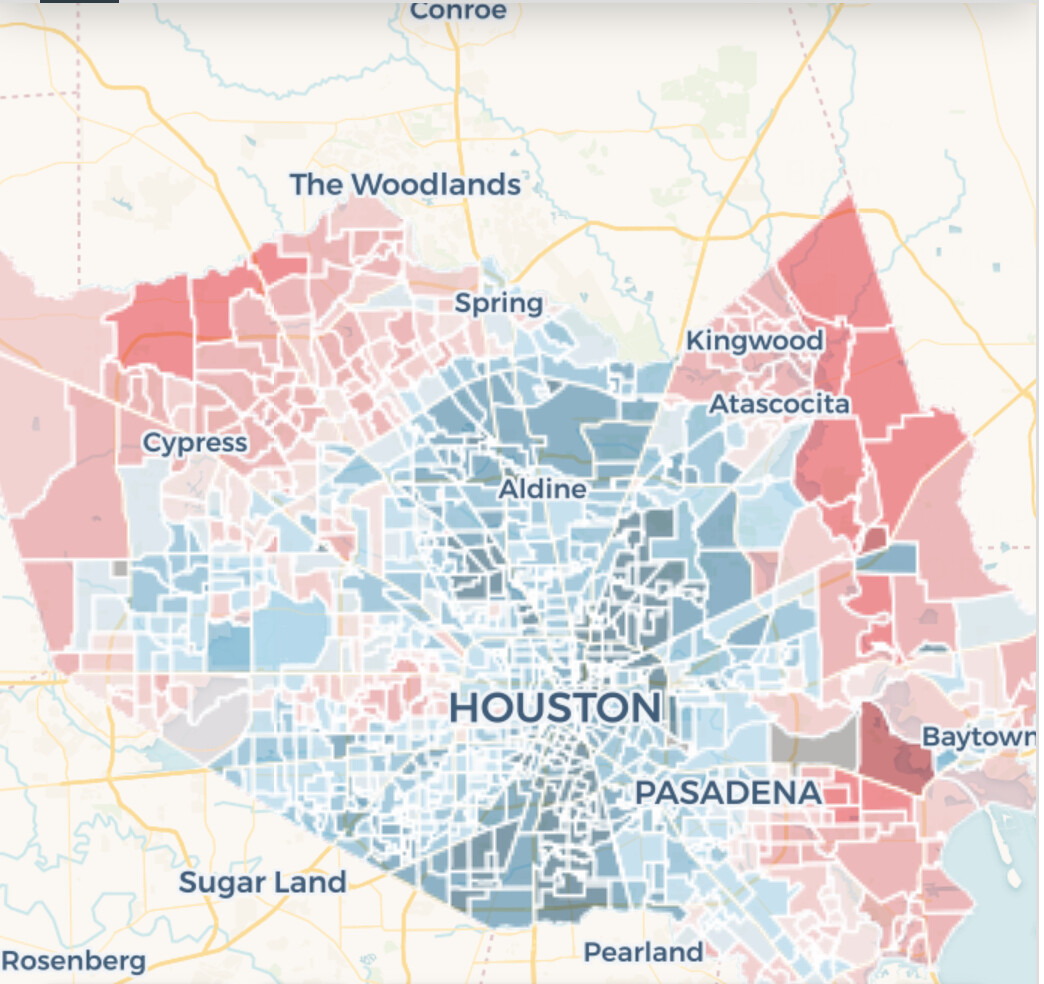
Here is the 2020 voter turnout. The outter suburbs are still very red. Suburbs like Jersey Village and Champions used to be very red but have turned blue due to the increase in minority population in those areas.
If more minorities move to the outer burbs, then you’re going to see flights again. Where? I don’t know. But if they go even further outward in masse, it’s going to cause deforestation which is killing the climate.
Conservative, even fiscal conservatism, isn’t sustainable because the “free” market is coming at a cost to the climate. |
Houston is eventually going to experience mass gentrification as I said, in both the inner loop but also between the loop and beltway where cheap housing still exists. The outer suburbs are not going to be able to afford the infrastructure and maintenance in the long run especially as the energy transition speeds up (which conservatives, light bulb, want to slow down as long as possible)
We can stop urban sprawl. We can protect our forests. We can put implement a carbon tax. Most importantly, we can speed up the transition to sustainable energy.
But unfortunately, this is not going to be cheap. And one of the main reasons people move to the burbs other than better schools, is because they can buy a big ol’ McMansion for cheap. But once taxes increases, then those cheap McMansions aren’t gonna be so cheap anymore.
That’s the problem.
Duce630
(DustinK - Damn it feels good to be a Cougar. -Dwight Davis)
29
Back to the original subject which was playgrounds, you still fail to recognize that more green space for recreation and for kids isn’t that hard of a sell to voters. They aren’t going to run for the hills if that includes climate change goals.
Stuff like a carbon tax (which is way behind the initial article), sure, you’ll get a ton of push back.
Duce630
(DustinK - Damn it feels good to be a Cougar. -Dwight Davis)
30
Stereotype is the wrong word but T-Moar isn’t wrong about the demographics, especially in the Houston area. Also I think you will find in the Houston area, a lot of Asian and Indian immigrants settled in the suburbs back in the 70s and 80s.
Also, I’m still wondering what suburbs are between the loop and the beltway.
It’ll sell in blue areas (i.e. the inner loop of Houston), but it’s going to be a hard sell in red areas.
Can it be done in red areas? Perhaps. But again, the entire reason the climate is getting worse in the first place is because of urban sprawl. So it’s really a catch-22.
Asians and Indian immigrants settled in suburbs that were mostly Asian and Indian. Same with Hispanics (Aldine/North Houston)
Over the past 2-3 decades, that has slowly changed, as more minorities have settled into predominantly white suburbs. You can’t erase the past, and suburban sprawl largely was racist at its foundation.
Not sure what you mean by “what suburbs between the loop and beltway”. There are a ton of suburbs, but they’re are minority dominated (hence the development of outter ring suburbs like Woodlands/Sugarland/Cypress etc. I would say Katy, but Katy is seeing an increase in minorities. Katy is turning into what Jersey Village and Champions/1960 have become.)
Duce630
(DustinK - Damn it feels good to be a Cougar. -Dwight Davis)
34
No it isn’t a hard sell in “red” areas. People want better recreational spaces. They also want better flood control. You combine those two goals, you’ll have a winner.
Show me where it has been done? And if it hasn’t been done, why?
Duce630
(DustinK - Damn it feels good to be a Cougar. -Dwight Davis)
36
In a previous post you pointed out many suburbs were between the loop and the beltway. I’m just asking what suburbs you’re referring to. Most of what I can think of the beltway barely touches any suburbs.
I reiterate, the very problem that’s worsening the climate is suburban sprawl. The reason that green spaces need to be implemented is because whatever was already there is harmful to children.
And again, these green spaces aren’t going to mitigate the climate issue. It’ll provide relief for playgrounds and such, but ultimately, it won’t stop the main issue.
Eventually, we will have to stop depending on fossil fuels, and many of these outer suburbs aren’t built for a post-fossil fuel economy, especially if taxes and energy costs spike.