A New Disturbance in the Force

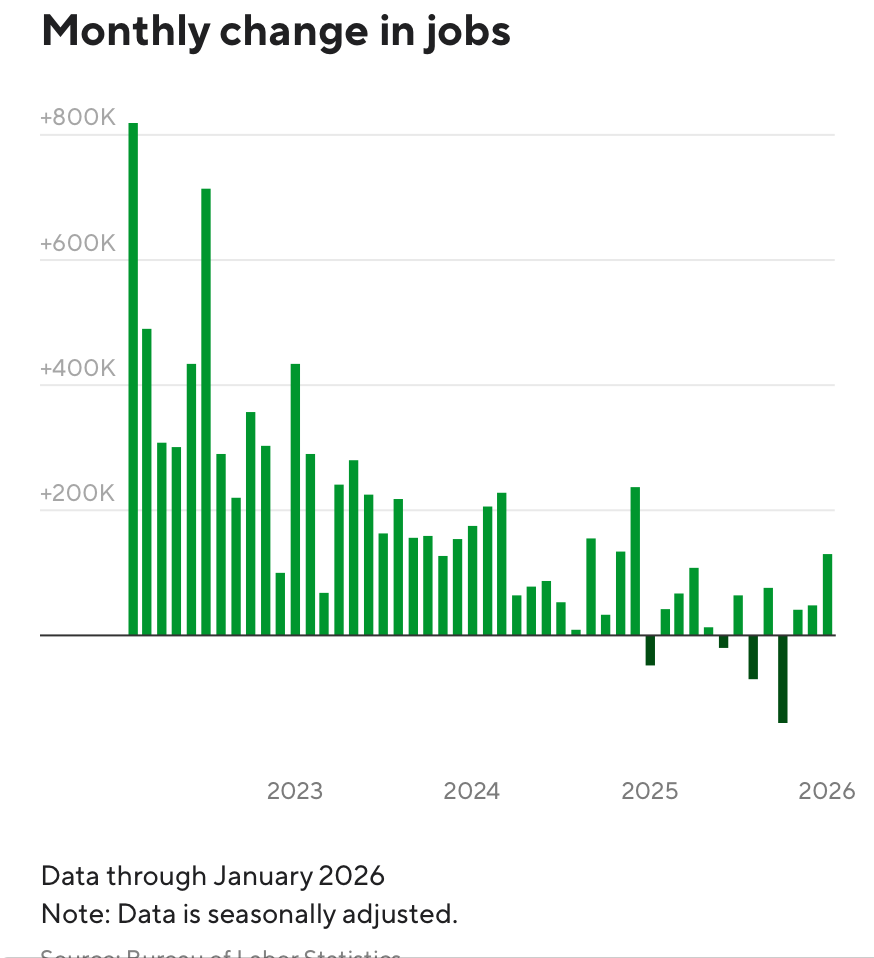
Bad job numbers.

Companies in the private sector added just 22,000 jobs in January, payroll processing firm ADP said Wednesday.

The figure is well below economists’ estimates of a gain of 48,000 jobs. The prior month’s payrolls number was revised lower to a gain of 37,000 from an initially reported gain of 41,000.

“Job creation took a step back in 2025, with private employers adding 398,000 jobs, down from 771,000 in 2024,” said ADP chief economist Nela Richardson. “While we’ve seen a continuous and dramatic slowdown in job creation for the past three years, wage growth has remained stable.”

I have enjoyed a great run up in my portfolio especially during the last 2 months. Recently, I noticed that XOM, which had a marvelous run, has a PE ratio of 22. I was shocked. Oil companies hardly hit 20. So, I’m going to cut exposure.

Most shocking, Walmart, which has a PE of 44. That is asking for trouble. I cut my exposure by 50%

I’m not sure what happens going forward but these PEs tell me that too many stocks are richly valued. You younger guys may want to keep riding the dragon but old guys have to be careful.

BTW, I bought a lot of Amazon at 160 a while ago. Sold it around 240 and was kinda po’d when it kept climbing. Now it’s dropping with all the tech stocks. I would love to buy back in if it bleeds out some more.

Bottom line, it’s a time to be careful and consider taking some profits.

7 Likes

Definitely an economy with mixed messages

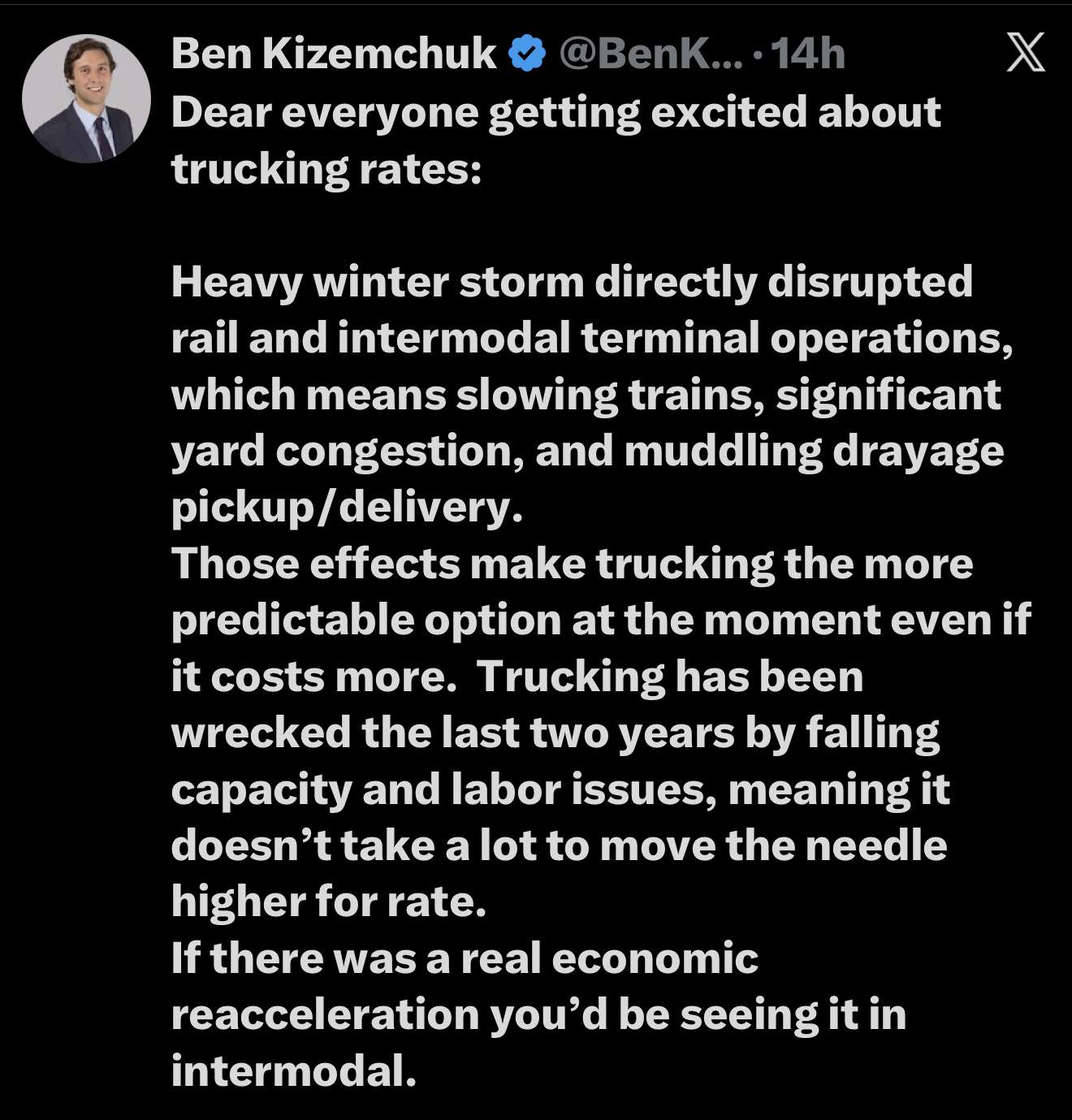
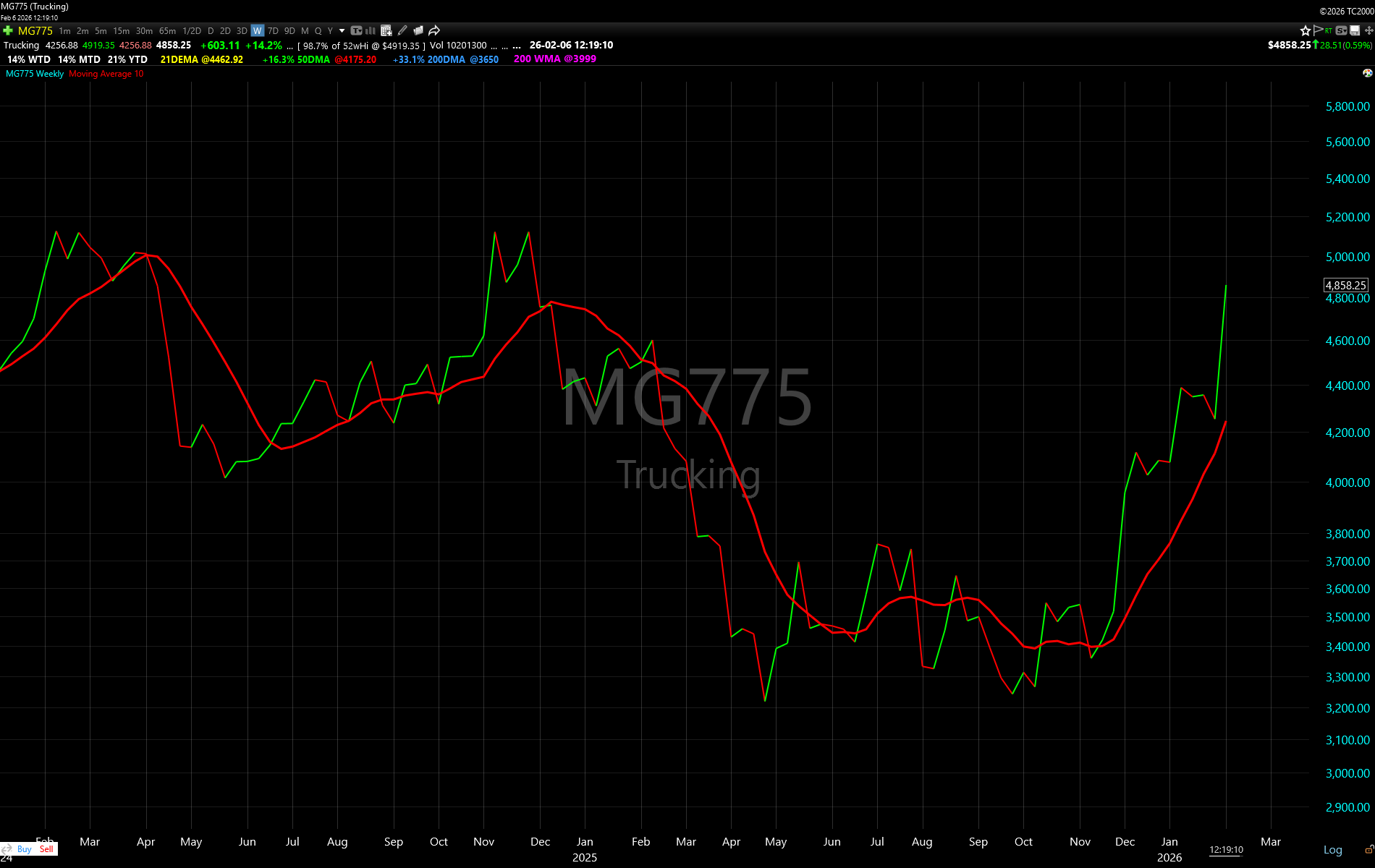
Trucking keeps on…

Here’s a couple of years of weekly closes for a trucking index.

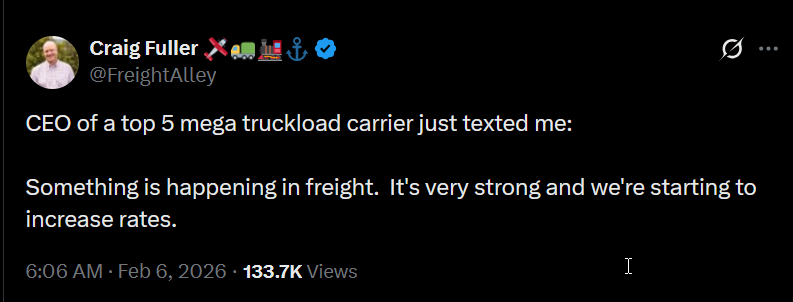
And here’s a trucking anecdote from X —


https://x.com/FreightAlley/status/2019744407595971009?s=20

—FOLLOW UP—

Been that way since the pandemic. I’m sure longer but it’s been very clear since then.

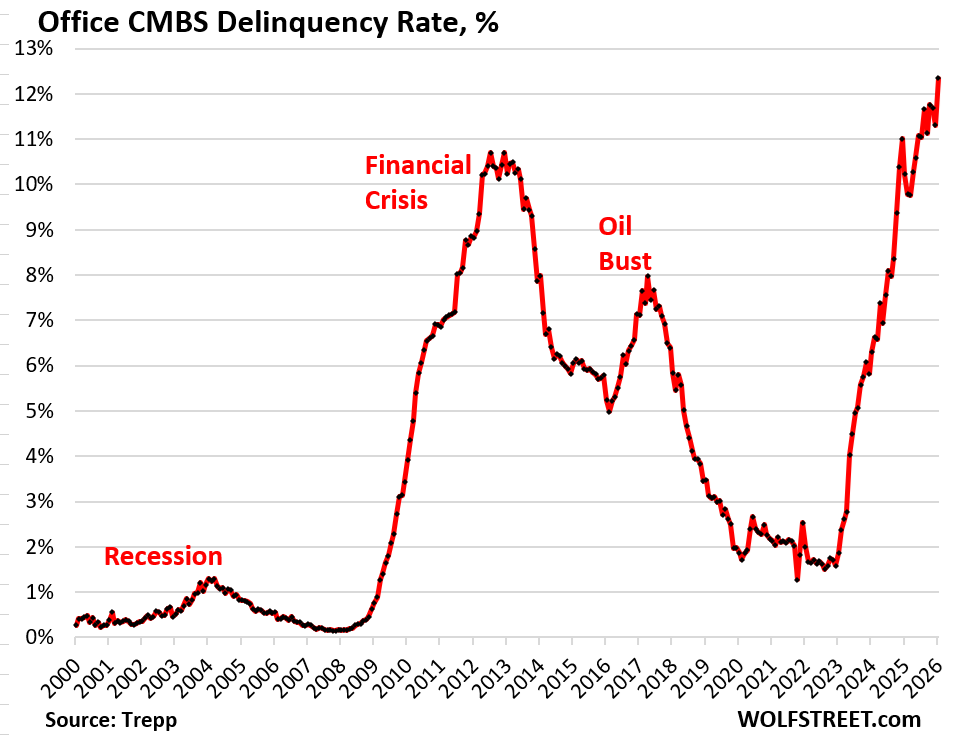
This isn’t a great indicator.

https://wolfstreet.com/2026/02/03/office-cmbs-delinquency-rate-spikes-to-record-12-3-much-worse-than-financial-crisis-meltdown-peak/

1 Like

Too many offices coming into the economy?

Slap tariffs on them–all fixed.

/s/

1 Like

US retail sales unexpectedly flat in December

The flat reading in ‌retail sales last month followed an unrevised 0.6% increase in November, the Commerce Department’s Census ‌Bureau on Tuesday. Economists polled by Reuters had forecast retail sales, which are mostly goods and are not adjusted for inflation, would rise by 0.4%.

country slowing picking up, the tariffs were never going to have as bad an affect as some wanted; govt costs beat tariffs on negatively affecting the economy every time. looks like more deregulation is on the docket next; that’ll push growth up some more.

1 Like

Some good jobs news in January. There was some negative adjustments to November and December jobs numbers (~-20K) but overall solid report.

1 Like

Benchmark revisions 4/24 to 3/25 revised down almost 900k

1 Like

At the same time, the report showed weaker hiring in 2025, with major revisions that reduced the number of jobs created last year to just 181,000, the lowest since the pandemic year of 2020. It’s also less than half the previously reported 584,000.

1 Like

Good news is federal government jobs declined

Total nonfarm payroll employment rose by 130,000 in January. Job gains occurred in health
care, social assistance, and construction, while federal government and financial activities
lost jobs. Payroll employment changed little in 2025 (+15,000 per month on average). (See
table B-1. See the note at the end of this news release and table A for more information about
the annual benchmark process.)

Health care added 82,000 jobs in January, with gains in ambulatory health care services
(+50,000), hospitals (+18,000), and nursing and residential care facilities (+13,000). Job
growth in health care averaged 33,000 per month in 2025.

Employment in social assistance increased by 42,000 in January, primarily in individual and
family services (+38,000).

Construction added 33,000 jobs in January, reflecting an employment gain in nonresidential
specialty trade contractors (+25,000). Employment in construction was essentially flat in 2025.

In January, federal government employment continued to decline (-34,000) as some federal
employees who accepted a deferred resignation offer in 2025 came off federal payrolls. Since
reaching a peak in October 2024, federal government employment is down by 327,000, or 10.9
percent.

Financial activities employment declined by 22,000 in January and is down by 49,000 since
reaching a recent peak in May 2025. Within the industry, insurance carriers and related
activities lost 11,000 jobs over the month.

Employment showed little change over the month in other major industries, including mining,
quarrying, and oil and gas extraction; manufacturing; wholesale trade; retail trade;
transportation and warehousing; information; professional and business services; leisure and
hospitality; and other services.

In January, average hourly earnings for all employees on private nonfarm payrolls rose by 15
cents, or 0.4 percent, to $37.17. Over the past 12 months, average hourly earnings have
increased by 3.7 percent. In January, average hourly earnings of private-sector production and
nonsupervisory employees rose by 12 cents, or 0.4 percent, to $31.95. (See tables B-3 and B-8.)

The average workweek for all employees on private nonfarm payrolls edged up by 0.1 hour to
34.3 hours in January. In manufacturing, the average workweek edged up by 0.1 hour to 40.1
hours, and overtime was unchanged at 2.9 hours. The average workweek for production and
nonsupervisory employees on private nonfarm payrolls increased by 0.1 hour to 33.8 hours. (See
tables B-2 and B-7.)
2 Likes

WASHINGTON (AP) — The nonpartisan Congressional Budget Office’s 10-year outlook projects worsening long-term federal deficits and rising debt, driven largely by increased spending , notably on Social Security, Medicare, and debt service payments.

Compared with the CBO’s analysis this time last year , the fiscal outlook has deteriorated modestly.

1 Like

And this is exactly what was anticipated when our last round of terrible budget decisions was being debated.

Even CNBC’s Steve Leesman who dislikes the current administration, was surprised. Couldn’t see a “pass along price increase from tariffs”

Price pressures in the U.S. eased at the start of 2026, with the annual rate of consumer-price inflation slowing from 2.7% in December to 2.4% in January. The reading was below economist expectations of 2.5% and marked the lowest inflation print since May 2025.

On a monthly basis, headline CPI rose 0.2%, slightly below both the prior reading and consensus estimates of 0.3%.

Core inflation — which excludes food and energy — also cooled, edging down from 2.6% year over year in December to 2.5% in January, as expected. This marked the lowest core inflation reading since March 2021.

Month over month, core CPI increased 0.3%, meeting forecasts and ticking up slightly from December’s 0.2% gain.

2 Likes

It’s a good sign and hopefully continues.

1 Like