Except neither has really taken a dont worry be happy approach…
Its Sweden that was supposed to be “dont worry be happy” right?
Heres some Swedish response.
On 10 March
the Public Health Agency of Sweden raised the level of risk of the virus spreading from " high " to " very high ", which is the highest level. This comes after news that there are indications of ongoing local transmission in the Stockholm and Västra Götaland area.[211][212]
At the same time, the agency advised everyone with respiratory infection, even mild ones, to refrain from social contacts in private and working life- where there is a risk of spreading the virus. They also ask health care staff in nursing homes and caring of elderly to not work if they have any symptoms of respiratory infection. Relatives of elderly should also avoid unnecessary visits at hospitals and in facilities for elderly and never visit if there are any respiratory symptoms.[213]
After this announcement, Blekinge Health Care Region enforced a total ban on visits by family members and friends at health care and elderly establishments and hospitals in the region.[214] Region Värmland enforced a similar ban on all visits to hospitals and health care establishments in the region.[215]
After the announcement of the Public Health Agency of Sweden to protect the elderly and the frail, Stockholm Region decided to change their strategy for testing for COVID-19 to mainly focus on the very ill and not just people who had visited risk areas.[216] Danderyd Hospital also went into a state of readiness due to the situation of the Covid-19 spread in Stockholm.[217]
On 11 March the Stockholm region decided to only test hospitalised patients from risk groups and health care staff with symptoms. Other regions will follow suit within the coming week. This means the data on the Public Health Agency of Swedens website is not reflecting the actual infected persons in the country, since local transmission has been ongoing since at least early March.[151][152][153]
The same date, Södertälje Hospital went into a state of readiness due to the situation in Stockholm region.[216]
The government has banned all gatherings larger than 500 people, under threat of fines and a six-month prison sentence.[12]
The same date, the government announced that the qualifying day of sickness (’ karensdag ') will be temporarily abolished in order to ensure that people feeling slightly ill will stay at home from work. This means that the state will pay sick pay allowance from the first day the employee is absent from work. The decision is effective as of 11 March 2020 and is believed to reduce the virus spreading as well as the burden on the health care system.[218]
On 13 March , the government decided to temporarily abolish the demand of a doctor’s certificate for 14 days for people staying home from work due to illness (i.e. sick pay period). Previously a doctor’s certificate was needed after seven days.[219]
The Public Health Agency of Sweden also declared the same date that stopping the spread of Covid-19 has entered a “new phase” which requires “other efforts”. The continued focus is now to delay spread among the population and to protect the elderly and most vulnerable against the disease.[220] On the same date, 814 persons in Sweden had been confirmed sick with Covid-19. Stockholm region has since 11 March only tested persons from risk groups and health care staff with symptoms.[151] On 12 March, Skåne region decided to do the same, and the other regions in Sweden will follow suit within a week.[152][153]
On the same date, media reported that there is a shortage in personal protective equipment (PPE) for health care staff, and hospitals in Stockholm have been forced to reuse disposable PPEs after sanitation. The regional Health Care Director warned about this scenario in early March and government agencies have temporarily waived the public procurement law in order to hastily procure more supplies.[221] The National Board of Health and Welfare (’ Socialstyrelsen ') confirmed that there is no preparedness storage and nothing to distribute to the health care sector.[222][223]
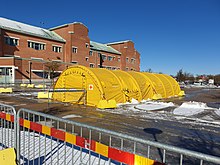
Medical tent set up outside Visby Hospital, 14 March 2020.
On 14 March , the Swedish Ministry of Foreign Affairs advised against all non-necessary trips abroad, in other words visits and tourist travel. The recommendation is valid until at least 14 April, when a new decision will be taken.[224]
On 16 March , the Public Health Agency of Sweden recommended that people over 70 should limit close contact with other people, and employers should recommend their employees work from home.[225]
On 17 March , the Public Health Agency of Sweden recommended that secondary schools and universities use distance learning.[226]
On 19 March , the Public Health Agency of Sweden recommended that people avoid unnecessary weekend trips within Sweden[227]