HALF of all the colleges/universities that have closed or merged since 2020 have been CHRISTIAN affiliated.
Comments?
HALF of all the colleges/universities that have closed or merged since 2020 have been CHRISTIAN affiliated.
Comments?
Just did a brief skim of the article but I’m not surprised that most would
be Christian, since that is the dominant religion in the country.
And the schools closing are tiny. One had 1,800 students, and article seems to imply it was big. Today’s 6A high schools are bigger. Religion has been on a long slow decline in this country for decades.
Schools are going all out to get students these days. Many don’t have any SAT or ACT requirements anymore. Just basically need a pulse. My kid, in 10th grade, is already getting unsolicited mail outs from schools almost weekly.
Then too, the cost is significant. Look at the enrollment at the community colleges
like Lone Star or Houston Community College. They are each over 100,000 students.
The decline in birth rates will not help.
Well UH does have a built in advantage in a city with 8 million and commuters to help if costs rise. I think UH will be ok. Private schools have more of a problem or they need to subsidize tuition more .
I tend to think this is more about your first point than your second. These schools have been under financial pressure for years because they just can’t operate efficiently enough to offset rising operating costs. When they raise tuition in response, that just drives down their enrollment (or makes it stagnate).
Some of them turn to athletics just to get more students on campus, which creates even more overhead that only makes sense if enrollment grows, but it puts pressure on the bottom line. And as you note, they become less selective in admissions, which isn’t good for the long-term health of the school if it isn’t managed.
The larger trend is declining university enrollment, so these small “niche” schools are going to have to get creative to stay relevant (and open).
Fair point. Latest data seems to indicate religious participation has stabilized and
youth participation shows an uptick, with this caveat:
Pew said their “latest surveys contain mixed signals about what is happening among young adults.”
It’s the cost. These students are spending the rest of their lives trying to pay off their college debt.
It’s particularly brutal for private colleges.
I went to HS with someone that went to a private Christian school that came out with $70k+ in debt and didn’t even end up graduating.
Univ St Thomas in Houston - $18,000/semester
HCU ( was HBU, dropped Baptist from name) $19,000/semester.
HCC - $1,000 for 12 hour semester
LSC - $1,300 for 12 hour semester
Dern. That’s a ridiculous sum of money. For that amount, they’d better have an inside track on running a corporation.
My daughter went to a local community college and got her nursing degree in 2 years
Yeah, my D3 undergrad alma mater has well over 100 on the team.
But they’re non-sectarian/non-religious.
At the D3 level, there are no athletic scholarships, but need based financial aid and other sorts of scholarships (academic, etc) are still available.
But even at the D3 level, I’ve heard the coaches admit that recruited athletes, especially in football, do get an extra thumb on the scale for admissions.
Yeah, I’m a little surprised it’s only half. There are a ton of minuscule regional sectarian schools. Idk how Southeastern Beaumont Dominican University or whatever stays open.
The return on investment isn’t worth it anymore for most majors. Especially with multi 10k semester tuition’s. Even a highly affluent student would struggle to pay that bill without large loans. And after that the job market has been so bad for an extended period of time for graduates that it’s almost better to go into a mentorship and networking to be decently successful compared to our median population.
That will be a massive factor in coming years which will hopefully increase wages and job prospects, but with how politics, AI, and excess offshoring/visas are going; that effort might be folly. The economy doesn’t seem to lend favor to the average American graduate, let alone the average American, no matter who runs it. Just feels like nobody actually cares and we keep flip flopping between two parties that aren’t going to help.
But anyway, current theory is (regarding college grads) since junior positions are being taken by AI/Offshoring/Visas due to cost, there’ll be a massive gap in experienced early-post grads causing a major shift in wage growth, while also allowing put together seniors to clean up and lead these teams; basically forcing the previous status quo of everything returning to the US and building pipelines back to American colleges.
I agree with much of your take on this topic except the above sentence. When and what is the “ previous status quo” of everything returning to the US ? What specifically has returned and when did this happen ?
1940’s to mid 1980’s was the status quo (2010’s can be included, but was quickly reversed and de-accelerated by the 2020’s), specifically mass offshoring and visas were never a thing before this shift to outsourced manufacturing, logistics, and even labor. This has now pushed into the White Collar market with mass visa imports (some even call it visa fraud), replacing college graduates with easily controlled imported labor (due visas needing sponsorship, companies pay well below market rate along with push the threat of firing and removal from the US. Essentially a form of indentured servitude) ultimately leading to a decline in said college → job pipelines
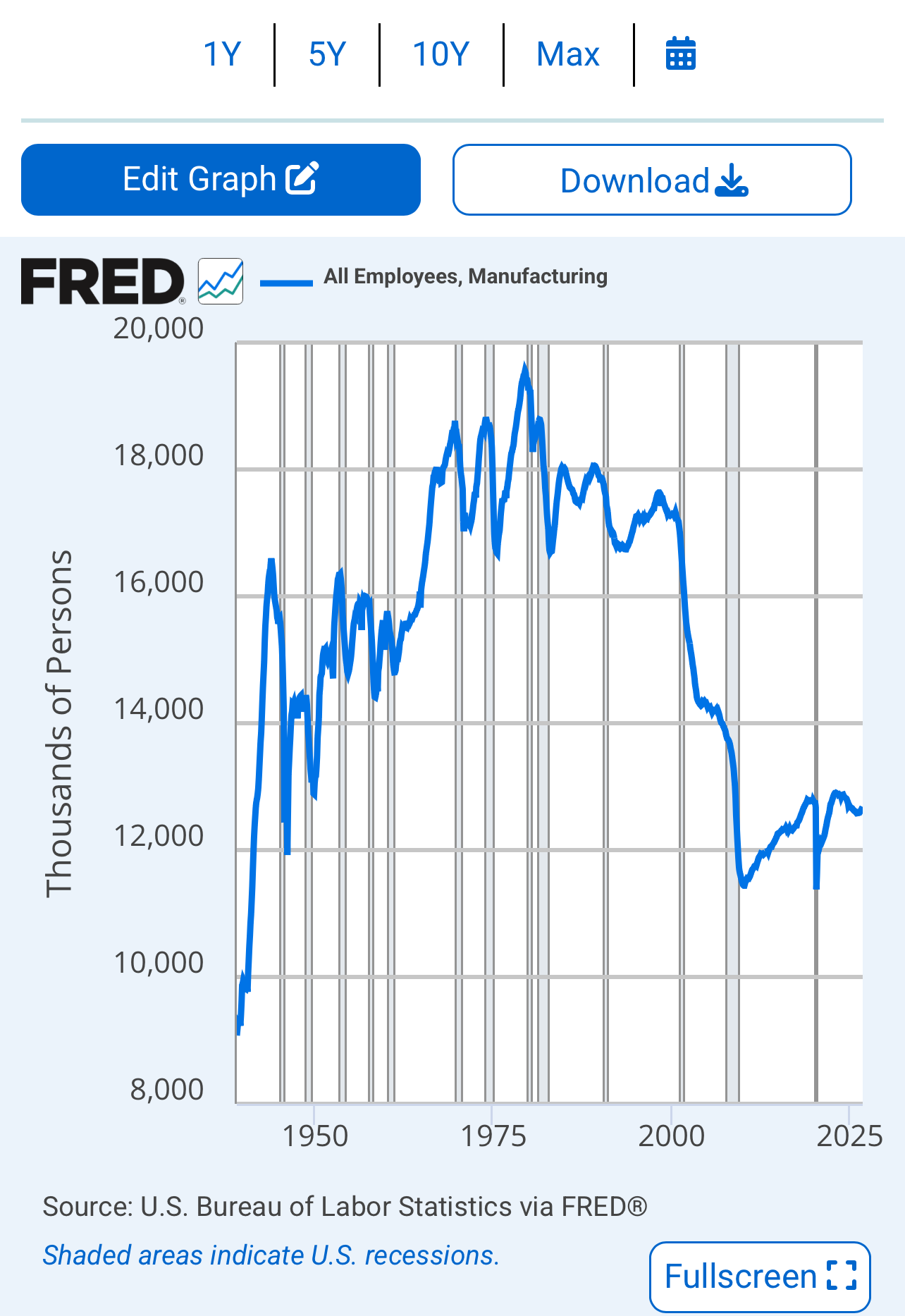
Okay; I was looking at the manufacturing
employment numbers and the 1940s was our peak per capita probably. 1980 was the all time high and it’s been a long 50 year decline.
I just don’t ever see us returning to the 1980 or 1940s peaks in manufacturing.
As for college graduates, I think there future is not very rosy. I really couldn’t insist it’s wise to
get a college degree today; otoh, in a tight market it’s good to have as much education as possible to distinguish oneself. But the large lifetime financial benefit of having a college degree may be a thing of the past.
The problem is that you don’t know how the payout looks until you’re pretty far into the game.
I would tell people the same thing today that I would have 30 years ago - going to college doesn’t guarantee you anything, but it opens up more opportunities than not going. It’s not a good fit for everyone and never has been. And many people who do go put limits on their opportunities (don’t want to move, don’t want to try new careers, don’t want to be uncomfortable) that also limit the “payoff.”
That said, the AI revolution could change everything very quickly.
Regardless of the future, I would never advise someone to go into 6-figure debt for an undergraduate degree. Work more to borrow less, even if it takes a little longer. That’s not as much an indictment of the value of a college degree as it is financial advice. These people who keep borrowing money to get masters and doctoral degrees are generally financially illiterate.
© 1999-2026 CoogFans.com