what’s even more ironic is that solar power is the most prevalent and profitable in red states
blue states, which are more favorable towards renewable energy, actually need fossil fuels more than anyone or they would collapse economically

That’s great !
Coal comes in around $23 to make a megawatt hour of electricity with the next best thing being gas at around $44 and those lovely renewables are barely in the same neighborhood with wind costing around $142 and solar costing around $396.
So, even more of the country is paying over 17 times what they could for energy. The usa has 27% of the worlds coal, the cheapest energy and it keeps on going with solar and increasing energy costs on those who can least afford it, the poor. The good news on this is the obese poor will lose weight. Between the rising energy costs from solar and AI datacenters, they’ll have to eat less to be able to afford electricity.
Pollution
Please post source of the numbers you are throwing out.
Yeah, those are made up or they don’t compare apples to apples.
On a smaller scale, I have a solar system on my house that cost roughly $30K to install in October 2025. It is on pace to produce 22MWH over the course of a full year.
That would be $1.36 per KWH in year one. I’m fairly certain you can’t build a new natural gas power plant and generate electricity for $1.36/KWH in year one, and a residential solar system isn’t as efficient as a larger one.
People get so wrapped up in their politics about this stuff that they completely take leave of their senses. Building a new natural gas plant costs about $22,000/KWH.
https://www.reuters.com/business/energy/rush-us-gas-plants-drives-up-costs-lead-times-2025-07-21/
Here is ChatGPT’s response.
Short answer: No, those numbers are not representative of current U.S. electricity generation costs.
There are a few problems with the claim:
- The coal, gas, wind, and solar numbers are likely from different studies, years, or assumptions
The post claims:
- Coal = $23/MWh
- Gas = $44/MWh
- Wind = $142/MWh
- Solar = $396/MWh
Those wind and solar figures are far above what most modern analyses show for new utility-scale projects.
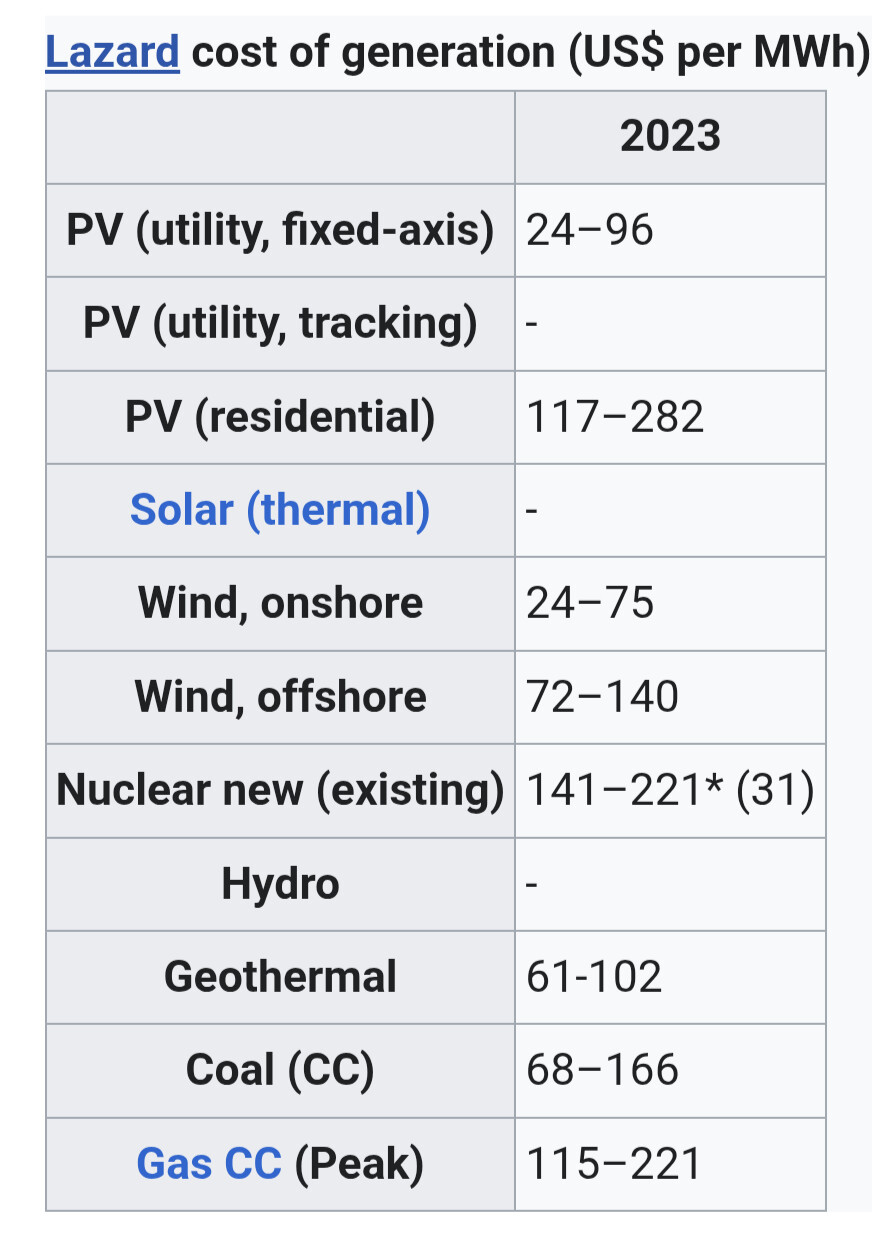
For example, Lazard, one of the most widely cited energy-cost studies, reports roughly:
- Utility solar: ~$38–78/MWh
- Onshore wind: ~$27–73/MWh
- Combined-cycle natural gas: ~$39–101/MWh
- Coal (new coal plants): generally much higher than gas and often above renewables
The claim’s solar cost of $396/MWh is several times higher than typical modern utility-scale solar estimates.
- It may be comparing existing coal plants to new wind and solar projects
This is a common trick.
An existing coal plant that was paid for decades ago can produce power relatively cheaply because the capital costs are sunk.
A new wind or solar farm includes all construction costs.
That’s not an apples-to-apples comparison.
If you compare:
- Existing coal vs. new solar → coal may look cheaper.
- New coal vs. new solar → solar is often cheaper.
- “The U.S. has 27% of the world’s coal”
That’s not correct.
The U.S. has large coal reserves, but not 27% of global reserves. Recent estimates are closer to roughly 20–25%, depending on the source and year. The U.S. is among the largest holders, but the percentage quoted is likely outdated or exaggerated.
- Electricity prices are not rising because of solar
Recent U.S. electricity price increases have been driven largely by:
- Natural gas prices
- Transmission upgrades
- Grid hardening/reliability investments
- Utility capital spending
- Inflation in labor and equipment costs
Solar and wind can create integration costs, but it is inaccurate to say rising power bills are primarily caused by solar.
- The AI datacenter point has some truth
AI datacenters are increasing electricity demand significantly. Utilities, grid operators, and regulators are actively discussing how to meet that demand. More demand can contribute to higher prices if generation and transmission don’t keep pace. That part is at least directionally reasonable.
My assessment
The post mixes:
- A legitimate concern (AI increases electricity demand),
- A real debate (existing coal vs. new renewables),
- And several highly questionable cost figures.
I’d rate it mostly misleading. The biggest red flag is the $396/MWh solar cost. Modern utility-scale solar is nowhere near that in most mainstream analyses.
The last sentence about poor people losing weight is opinionated rhetoric, not an economic analysis.
Lame.

Cheap Natural Gas and Its Democrat Enemies
" These alternative energy sources all have problems associated with them. They are vastly more expensive than gas. For example, generating a megawatt-hour of electricity using natural gas costs $80; with wind it would cost $142, and solar would cost $396. Wind power is intermittent, interferes with birds, and is terribly inefficient; ironically, wind farms often must be backed up with natural gas-powered plants. Solar farms have a huge footprint and must be located in sunny areas; huge transmission lines trigger the NIMBY (Not In My Backyard) reflex. Ethanol, created by refining corn, has caused a spike in food prices, may require more energy to produce than it creates, and depletes aquifers (corn is a thirsty crop)."
okay, if we’re going to use AI to make a point; microsoft copilot said:
" A 2025 peer-reviewed Energy study found that when you account for full-system costs — including intermittency, grid upgrades, and transmission losses — solar in some regions can be far more expensive than coal Climate Depot. For example, in Texas , the study estimated:
- Solar: $413/MWh
- Wind: $291/MWh
- Coal: $90/MWh
- Nuclear: $122/MWh
Here, solar is over 4× more expensive than coal in that analysis Climate Depot. The reason is that solar’s intermittency requires backup or storage, which adds cost, and in less sunny areas, the same panel size produces less energy, raising the per-kWh cost."
looks like the $396 cost i used was low for solar.
You really needed to provide that context. That’s a different ballgame and not apples to apples.
Your numbers also changed.
And there are studies from very reputable sources showing very different results as has been shown.
Finally, I’d be careful with copilot. It’s bottom of the rung in AI for this kind of stuff.
The Numbers You Cited- These specific figures (e.g., $413/MWh for solar) represent specialized, worst-case cost estimates often cited by advocacy groups like Climate Depot. They factor in theoretical, long-term costs for storage, grid upgrades, and transmission to balance intermittency and grid upgrades, it represents a specific methodology rather than the standard wholesale market costs.
This is some first class intellectually dishonest shilling
Intellectually? 

The coal fired plants throw that in for free, no extra charge!
Need to use better sources. climatedepot.com is not a site you want to be relying
on for information.

It’s funded through Donors Trust, so easy to see why people get hornswoggled
by these organizations that try to hide who funds them.
I just want to chime in and say each source of energy (outside maybe coal these days) has its place of purpose in supplying energy to the public. Wind, solar, gas (CC and peaker), nuke, battery, etc. They all have a place in the system.