I want Wild West pay for play. Who decides fair market? The SEC or Big 10?
Why are you posting info on the House Settlement, which Tech approved and joined? That settlement did not include the proposed agreement that’s being forced on schools now.
And please list which schools have signed the proposed agreement. Until there’s a critical mass that has signed, it’s just silliness to call any school who hasn’t “rogue.”
Tech’s president unadvisedly signed on early.
So, help us understand why what aggy does matters.
Simple.
Because it shows that the biggest names in college football in TX AREN’T siding with Paxton or Tech on this.
That is to say, the programs with enough clout to potentially challenge and influence something like this are blowing off Paxton and telling Tech, in effect, go rogue at your own risk.
You asked why we should disregard Paxton’s concerns, and that’s why: because the movers and shakers in the college football world are doing exactly that, so far as we can tell. Doesn’t make sense for us to do anything different, given that.
Tech and Baylor alone won’t win this battle, and as long as that is the case, we shouldn’t side with them and risk getting dragged down with them.
Maybe if either a) a large number of programs agree to oppose this, or b) programs with enough clout to truly influence this oppose it, we’ll reassess.
But guess what?
THAT AIN’T HAPPENING.
And unless and until it does, we’d be stupid to side with Tech and fail with them.
Ya gotta have the wisdom to choose your fights wisely, and only choose a fight when there’s some realistic prospect of winning. There is NONE here unless and until the things I mentioned take place.
Wake me up when they do. I suspect I’ll sleep soundly.
Because without this, there’s really no enforcement of the settlement.
Why agree with House, but NOT agree to do what it takes in order to let it be enforced and be truly binding?
It’s a meaningless settlement if you don’t.
All four Power Conference offices have already blessed off on this, so unless Tech and others want to get kicked out of the P4, they’d be well advised to bend the knee.
Don’t insist that UH get incinerated GOT style for not doing so. If Tech wants to die on this vine, fine. Don’t insist that we die with them.
We’ve fought too long and hard to get back in the Power Conference game to risk losing it all by fighting something that so few are fighting and that no one with any real clout is fighting.
Really dumb idea.
Very sorry to hear that you are taking ANYTHING Paxton has to say seriously.
When a guy who has been as big an embarrassment to the AG’s office as Paxton has says something, you’d be well advised to view it with suspicion.
We’ll reassess if/when enough schools or anyone with real clout takes Tech’s side. Trust me. I’m pragmatic and flexible enough to adjust fire on this if necessary. But I need to see more than Tech or Baylor whining before I will.
1 Like
You never answered the question.
What are the consequences for teams/schools that break this agreement?
The biggest question of all is the following:
What will happen to USC, bama, georgia, ohio state, michigan, florida, fsu, clemson, uta, atm if they break this agreement?
Again, tell us. You keep moving the goal post/step dancing around the most important part of this called agreement.
Unless we know exactly what the consequences will be not one school in their right mind should sign this agreement.
Why?
Because all of the blue blood schools/teams mentioned above have cheated for decades with different consequences. This agreement does not mention anything that these schools/teams will be hammered with appropriate consequences.
What it does is going back to the pre NIL era with a $20M’s pot. THAT IS IT
Too easily answered. All it takes is a simple Google search. Not sure why you didn’t do it and had to ask.
Schools that violate can forfeit one year of conference revenue distributions and receive a post-season bowl ban.
Anything else?
Without this agreement and the CSC, however, there will be no means to enforce the House settlement with any real teeth.
That’s why all P4 offices are behind this and only a few moron schools are balking.
Don’t insist that UH be one of those moron schools.
The problem isn’t with what happens to violators of the agreement.
The problem is what might happen to schools that won’t agree to the enforcement mechanism in the first place.
They could get kicked out if the P4.
We’ve come too far to risk that.
Therefore, DON’T insist that we risk that by doing what Tech is doing.
Let them risk expulsion on their own.
We will ensure our place in the P4 by agreeing to the rules and their enforcement mechanism.
Let Tech risk their place by refusing. DON’T put UH at that same risk.
1 Like
Go ahead post the consequences. So far what you are writing is basically the same as what the ncaa had pre nil.
The same blue bloods violated ncaa rules but were exhonerated after…further investigation. uta, directly benefited from it when we almost got the death penalty for the same exact “broken rules”
Does your agreement include prison sentences and 10 plus years probations?
I already did.
Go back and reread.
The consequences of not agreeing to this enforcement mechanism could be expulsion from the P4 which we will NOT risk.
The consequences of violating House could be loss of one year of conference revenue distributions and loss of bowl eligibility.
Don’t ask again.
Because as we say in court when people do that, the response will be….OBJECTION….ASKED AND ANSWERED!!!
Don’t ask again? Who do you think you are?
You have not posted anything that differs from the pre nil era. NOTHING That is exactly why the teetech donor is arguing about.
Moreover, who pushed for this charlatan agreement? The same blue bloods that cheated for decades.
There is a lot of difference.
First of all, what used to be under the table is now out in the open, and must be publicly disclosed.
Second, if any school breaks the new rules, the CSC can punish them in the ways I indicated.
But without the CSC, there is basically no enforcement mechanism and there are too many ways for schools to get around it.
That’s why it is in important for everyone to agree to the mechanism.
Those that refuse to, like Tech, should be kicked out for not agreeing.
Don’t ask UH to risk the same by not agreeing.
Really dumb.
Glad I’m not that dumb.
1 Like
Here is why law does not want to post the so called consequences of this agreement. Read between the lines and compare it to pre NIL era:
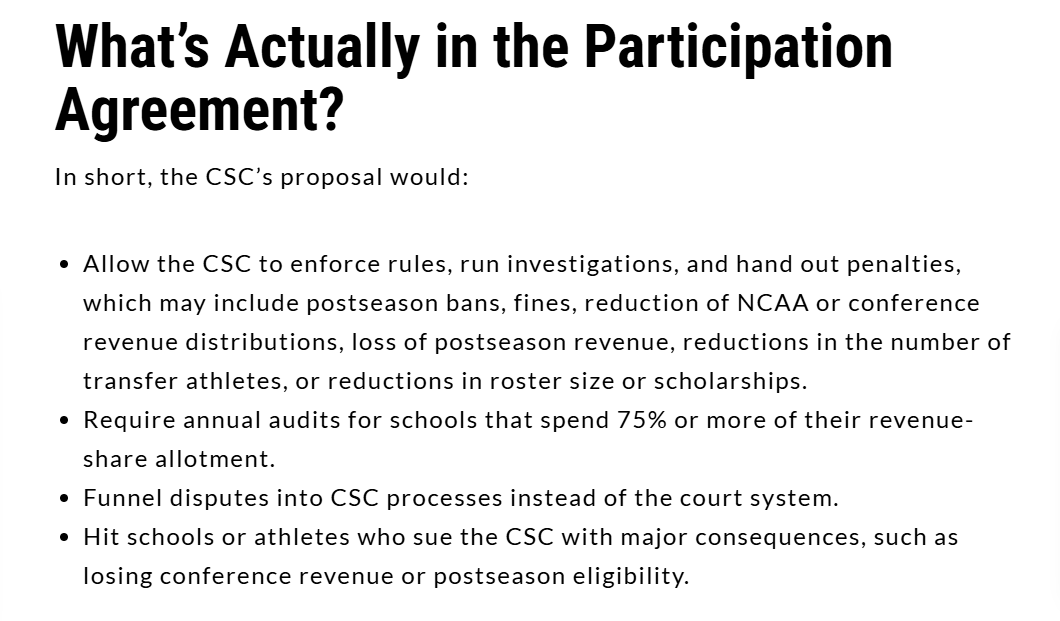
Does anyone see prison sentences?
Does anyone see a double digit probation?
It is basically the same bs that the ncaa had prior to the NIL.
Now ask yourself the following question because this is at the core of why this agreement was put together?
How did all of these blue schools/teams got away from paying players for decades? Remember the ncaa has rules. These rules had consequences for some and none for others. We know that all too well.
Without any real life changing consequences this agreement is pretty much a carbon copy from what the ncaa had.
Schools can manipulate their books. THEY ALREADY DO IT.
Run investigations? Yep, same type of investigation that let Auburn go free and keep their National Championship while USC got hammered.
This agreement has nothing in it of value that will really stop cheating. The blue bloods know it. That is why they want everybody to sign it.
We gotta add the following. That’s the kicker:
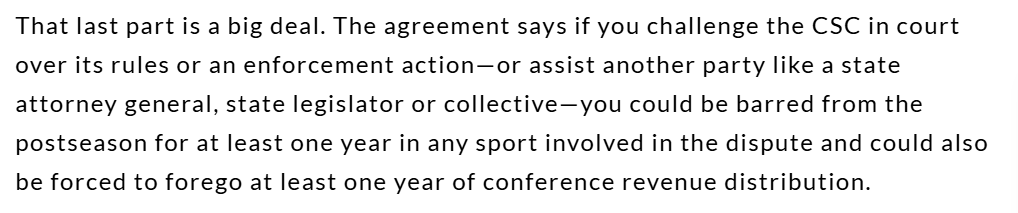
Translation:
You the accused have no say. You STFU and take your penalty.
This is exactly how the ncaa operated for decades.
Bro.
Without the CSC, there’s NO enforcement mechanism.
So you’re saying we should oppose the CDC because the penalties aren’t tough enough?
Well guess what?
Losing a whole year of revenue distributions is plenty. For a P4 school, that’s $40-$90 million.
And your state AG can’t sue to get you out of it.
Of course Paxton wants to be able to sue to get UT or aTm out of trouble if they violate.
WE want UT and aTm to NOT be able to do that.
We want them punished when caught with no recourse.
This agreement make that a real possibility.
Without it, there’s nothing.
Tech most likely is opposed because they want their billionaire sugar daddy to let them keep buying players with no strong enforcement mechanism against it, and want to have the AG sue on their behalf if they get caught.
WE should want the OPPOSITE.
We should want Tech to get fried with no legal recourse if/when they do that.
It’s a no brainer.
Could the punishments be worse? Maybe.
But without this, there’s NOTHING.
Something is always better than NOTHING.
Given that, we need to support it, otherwise, we’ll be left with NOTHING.
And if Tech or Baylor want to oppose this and have nothing, fine. Then let’s kick them out.
DON’T insist that we risk getting kicked out as well, because it appears that few are opposing this, and that’s the risk we take if we choose to be one of the few.
Since law refuses to be forthcoming here is a lawyer’s point of view"
“The College Sports Commission is begging for a legal challenge.
Why?
- It gives the CSC concentrated power: it investigates, prosecutes, and decides penalties.
- The agreement limits participants’ legal rights, including requiring arbitration and waiving jury trials.
- It clashes with many state NIL laws, even though it claims it doesn’t override them.
- Athletes could lose rights without realizing what they’re giving up.
Heitner also raised concerns about transparency. Audits sound good in theory, but the agreement isn’t clear about what information will be public or how consistently rules will be applied.
All of this adds up to a system that may stabilize NIL oversight on paper but opens up a lot of legal and fairness questions in practice.
Attorneys practicing in this space all seemed to agree as news of the participation agreement broke on X yesterday.
Mit Winter said, “Pretty big concession schools are required to make if signing this agreement.”
Attorney Ryan Mulvaney said on X: “Launch away. We’ll be right here, prepared to defend college athletes, collectives, and even schools.”
What This Could Mean Going Forward
For schools and athletes, especially those outside the major revenue sports, this new agreement raises some big questions:
- Will athletes in smaller sports be asked to sign paperwork that limits their rights without much leverage?
- What happens when state laws conflict with CSC rules — and who ends up paying the price?
- Will postseason access or budget stability become bargaining chips in enforcement actions?
The CSC says this agreement is about bringing order to a chaotic NIL landscape. But the CSC is asking for broad authority with limited clarity about how checks and balances will work.
As the details get debated and schools decide whether to sign on, expect lawyers, athletes’ rights advocates, and state lawmakers to weigh in.
There is much more to it.
Paxton advised Texas Universities not to sign.
So…has UT signed? A$M?
Nobody has signed as far as has been reported. You can spare yourself from reading a bunch of hand waving above to try to distract from that fact.
The agreement has been proposed, and it will not become effective unless everyone signs. Since each state has different laws addressing NIL issues, the agreement would not apply to all schools in the same way.
This is not a workable solution - it’s a conversation-starter.
1 Like
UT is the State’s Flagship and has its best Law School.
It creates lots of Legislators. Lots.
I would just wait and see what UT does. We do not have to reinvent the wheel.
As I said, if UT or aTm cries foul, then we’ll reassess.
Hasn’t happened yet.
1 Like
Unfortunately, legislators aren’t necessarily good lawyers, but I’ll be surprised if they agree to this initial proposal, at least until they see what the rest of the SEC does.