Here is some AI for you.
Question: Can you compare the windstorm engineering requirements between Houston, TX and Vancouver, BC?
Abridged answer: Houston’s physical wind forces on a building envelope are 4 to 6 times higher than Vancouver’s.
Answer: Comparing windstorm engineering requirements between Houston, Texas and Vancouver, British Columbia highlights the contrast between hurricane-driven tropical wind design and temperate maritime wind design. Houston’s proximity to the Gulf Coast subjects it to extreme wind hazards, meaning its structural engineering rules focus strictly on preventing catastrophic failure from tropical storms. Meanwhile, Vancouver’s parameters are significantly lighter, focusing primarily on winter storms and matching lateral stability with its massive seismic code demands.
Core Comparison Overview
| Parameter / Feature |
Houston, TX |
Vancouver, BC |
| Primary Code Foundation |
International Building Code (IBC) / ASCE 7-22 |
BC Building Code (BCBC 2024) / National Building Code of Canada (NBCC) |
| Design Metric Basis |
3-Second Gust wind velocity (mph) |
Hourly Wind Pressure (HWP) 1-in-50-year return (kPa) |
| Baseline Design Speed / Pressure |
120 to 140+ mph (varies by Risk Category) |
0.40 to 0.45 kPa (~65–70 mph equivalent 3-sec gust) |
| Wind-Borne Debris Region |
Yes (Requires impact-resistant glass/shutters) |
No (Standard glazing is acceptable) |
| Dominant Lateral Load Concern |
Wind Loads (Hurricanes dominate over very low seismicity) |
Seismic Loads (Earthquakes dwarf wind requirements) |
- Code Framework and Methodology

Houston, TX: Structural engineers utilize the ASCE 7-22 (Minimum Design Loads and Associated Criteria for Buildings and Other Structures) standard adopted via the local Houston Building Code amendments. The methodology is based on ultimate 3-second gust wind speeds measured at 33 feet above the ground in open terrain (Exposure C). [1, 2]

Vancouver, BC: Engineers design under the BCBC 2024 (derived from the National Building Code of Canada). Canada does not use direct wind speed maps for structural design equations; instead, it uses a 1-in-50-year Hourly Wind Pressure (HWP). This represents a sustained, hourly mean wind speed rather than a rapid gust. [1, 2]
- Wind Speeds and Pressures
-
Houston’s Severe Demands: Houston sits in a hurricane-prone region. For a standard building (Risk Category II), the design wind speed is generally between 125 to 135 mph, stretching up to 150 mph near coastal borders. This translates to base velocity pressures of roughly 40 to 55+ psf before applying shape factors. [1, 2, 3]
-
Vancouver’s Moderate Demands: Vancouver features a standard 1-in-50 HWP of 0.40 to 0.45 kPa (about 8.3 to 9.4 psf). Converted roughly to a 3-second gust equivalent for comparison, Vancouver’s design winds are around 65 to 70 mph—nearly half the velocity of Houston’s design threshold. Because wind pressure scales exponentially (V²), Houston’s physical wind forces on a building envelope are 4 to 6 times higher than Vancouver’s. [1, 2]
- Wind-Borne Debris & Glazing Protection
-
Houston (Impact Zones): Portions of Houston—especially areas falling near the coast or dictated by the Texas Windstorm Insurance Association (TWIA)—require Wind-Borne Debris Region (WBDR) compliance. Windows and doors must feature costly impact-rated laminated glass or structural storm shutters capable of withstanding large missile impacts (like a flying 2x4 timber). [1, 2]
-
Vancouver (No Impact Rules): Vancouver has no wind-borne debris mandates. Fenestration and glass design are governed strictly by standard deflection and water/air infiltration constraints under North American Fenestration Standards (NAFS).
- Interplay with Other Lateral Loads (The “Governing” Load)
-
Houston (Wind Governs): Seismicity in Houston is effectively non-existent (Seismic Design Category A). Therefore, wind load completely governs the design of the lateral force-resisting system (shear walls, bracing, and moment frames). [1]
-
Vancouver (Seismic Governs): Vancouver sits on a major tectonic subduction zone with severe earthquake risk. The newly enforced BCBC 2024 provisions bumped seismic design forces significantly. For almost all low-to-medium-rise buildings in Vancouver, earthquake forces significantly dwarf wind forces. The extensive “braced wall panels” or concrete cores engineered into Vancouver buildings are there to survive tremors, which incidentally makes them more than strong enough to handle local windstorms. [1, 2, 3, 4]
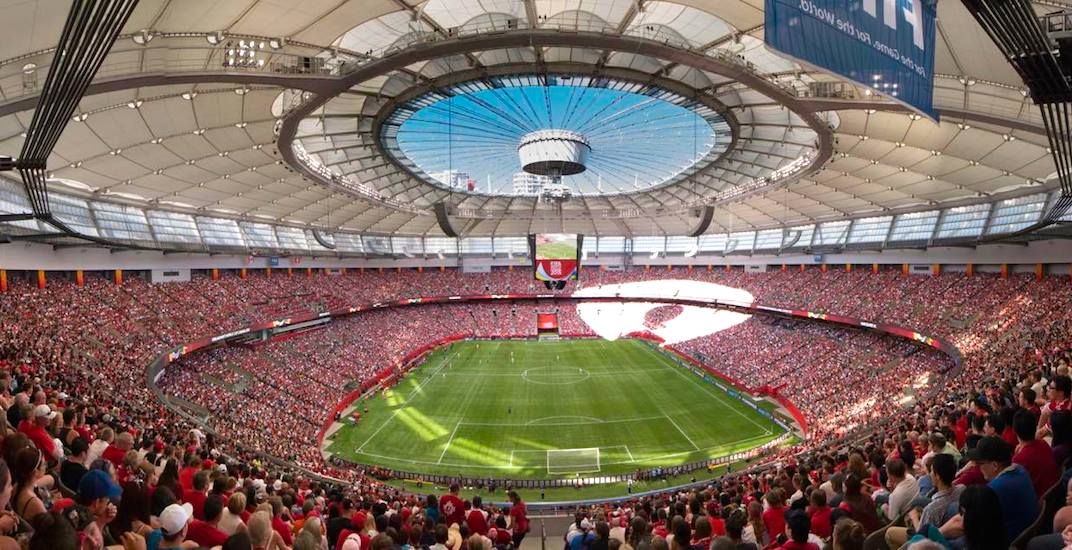
Question: Can you estimate the cost of building a canopy and structure similar to what they have at BC Place stadium in Vancouver over TDECU stadium in Houston, TX, account for additional structure for windstorm requirements, assuming existing structure of TDECU stadium is not designed for a canopy so additional, to the ground structure and foundations are to be accounted for.
Abridged answer: $260m-$390m
Answer:
Estimating the cost of building a BC Place-style canopy over the University of Houston’s TDECU Stadium requires evaluating a heavy civil and structural megaproject. Because TDECU Stadium’s existing concrete and steel infrastructure was not engineered to support a roof, we cannot tie into the current bowl. [1]
To execute this, engineers would have to build an independent exoskeleton structure—a ring of massive steel masts and deep concrete foundations completely surrounding the exterior of the stadium, much like the engineering behind BC Place’s iconic cable-supported system. [1]
The total estimated cost to engineer and construct this windstorm-hardened canopy over TDECU Stadium ranges from $260 million to $390 million USD.
Cost Breakdown Estimate
| Project Phase / Component |
Estimated Cost Range (USD) |
Cost Drivers & Parameters |
| 1. Foundations & Deep Piling |
$35,000,000 – $55,000,000 |
Massive concrete drill shafts down to stable soil strata to counteract immense wind uplift forces. |
| 2. Exoskeleton Steel Infrastructure |
$110,000,000 – $155,000,000 |
30+ major perimeter steel masts, compression rings, and the specialized cable net matrix. Heavy windstorm premium. |
| 3. Canopy Membrane (ETFE/PTFE) |
$45,000,000 – $65,000,000 |
High-tensile fabric panels covering the 40,000-seat bowl footprint. Includes retractable center mechanisms. |
| 4. Windstorm Engineering & Soft Costs |
$25,000,000 – $40,000,000 |
Complex boundary-layer wind tunnel testing, dynamic structural modeling, architectural and permitting fees. |
| 5. General Conditions & Contingency |
$45,000,000 – $75,000,000 |
20% premium for working over an active, existing stadium footprint with tight logistical constraints. |
| TOTAL ESTIMATED COST |
$260,000,000 – $390,000,000 |
Roughly 2.5 to 3.5 times the original $102M build cost of TDECU Stadium. |
Critical Engineering Cost Drivers
- The Houston Windstorm Premium (+25% to +35% on Steel/Cables)
The original BC Place roof renovation cost roughly $514 million CAD (~$380M USD at the time), but it was designed for Vancouver’s gentle 65–70 mph equivalent wind speeds. [1]
- Houston’s building codes mandate structures survive 130 to 140+ mph hurricane-force winds.
- Wind pressure scales exponentially with velocity ((P \propto V^2)). Houston winds will exert 4 to 6 times the lateral and uplift forces on the canopy compared to Vancouver.
- To prevent a massive canopy from turning into a sail and ripping apart, the steel cables must be significantly thicker, and the connection nodes require heavy-gauge steel welds and custom-forged components.
- The Foundation Exoskeleton
Because the stadium bowl can take no load, a series of massive steel masts must be erected around the perimeter of the “Cougar Cage”. [1, 2]
- Uplift resistance: Hurricanes create massive aerodynamic low-pressure zones over stadium bowls, trying to suck the canopy upward.
- To anchor the perimeter masts against millions of pounds of upward and lateral thrust, engineers would have to drill deep, large-diameter concrete friction piers (likely 6 to 8 feet in diameter, extending 80+ feet into Houston’s clay soils).
- Fabric Durability (ETFE/PTFE)
A BC Place-style roof utilizes dual-layer ETFE (Ethylene Tetrafluoroethylene) cushions or PTFE (Teflon-coated fiberglass) membranes. [1]
- The fabric chosen for Houston must be highly tensioned to prevent catastrophic tearing during a tropical event.
- It must also feature specialized UV-reflective coatings to combat intense Texas heat, keeping the uncovered bowl from turning into a greenhouse during summer months.
- The Retrofit Penalty
Building over a finished stadium is drastically more expensive than building from scratch. Crane placement will be highly restricted by the surrounding campus infrastructure, the nearby METRORail Southeast Line, and localized parking lots. Staging massive steel lifts will require highly complex logistics, driving up the construction management costs. [1, 2, 3]
Would you like to explore how changing the scope to a fixed, partial canopy (only covering the sidelines, like modern European soccer stadiums) would reduce these foundation and wind-load costs?
No one has ever said that it can’t technically be done, what they have said was it was going to cost north of $200m.