CoachV's Book Corner

1 Like

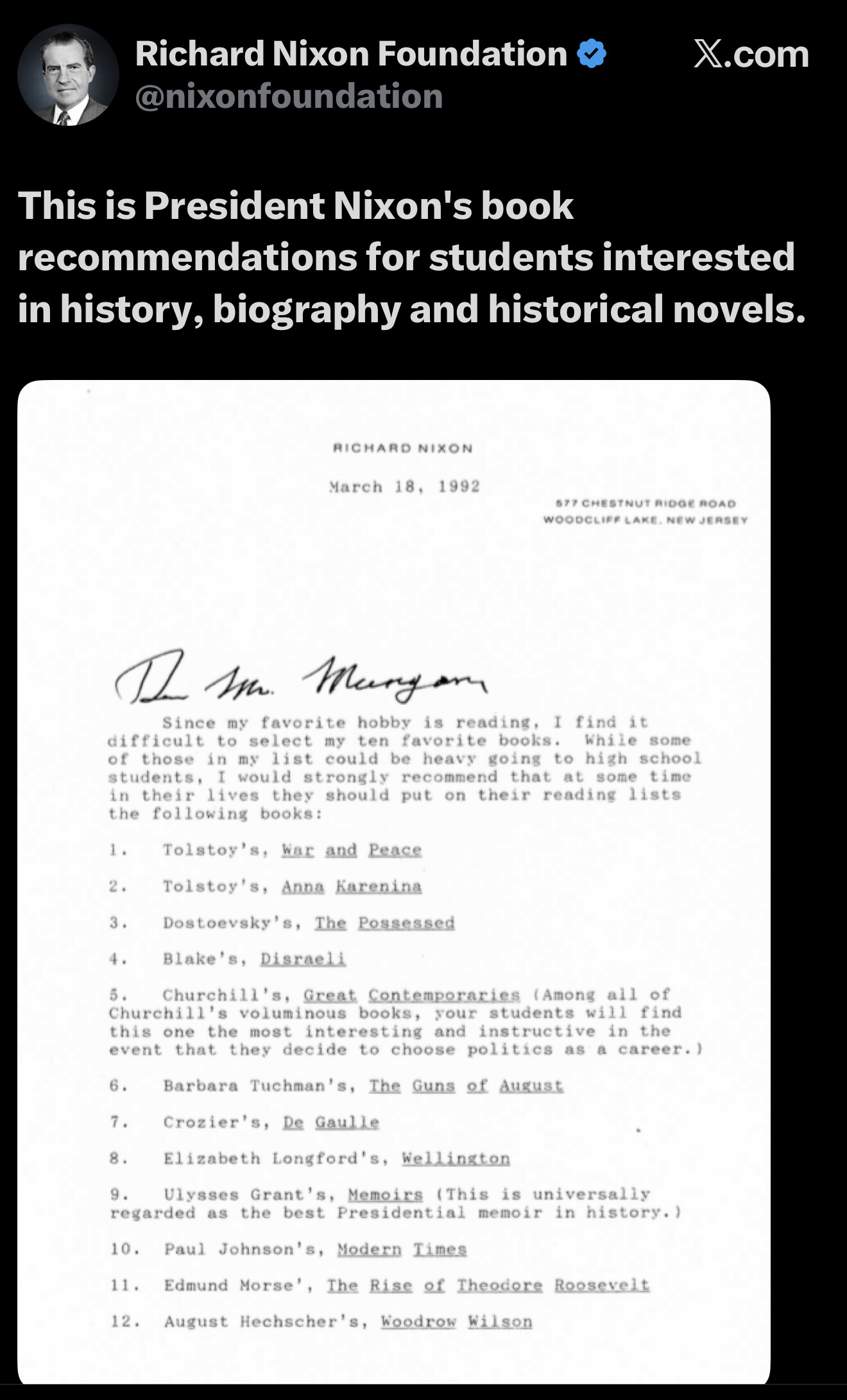
Tricky Dick with some light reading

2 Likes

More on Nixon from this Aug. '22 post above —

Reading “The Conquering Tide: War in the Pacific Islands, 1942–1944 (The Pacific War Trilogy, 2)” by Ian Toll
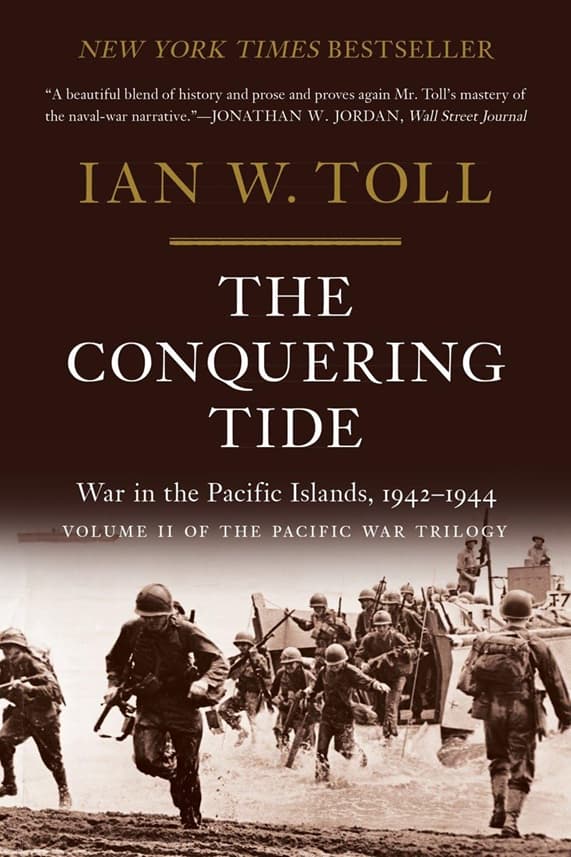
I’m about halfway through — pretty good. Gives Japanese general’s & admiral’s thoughts, views, doubts, debates which adds nice balance.

Snip from Amazon blurb — “…encompasses the heart of the Pacific War―the period between mid-1942 and mid-1944―when parallel Allied counteroffensives north and south of the equator washed over Japan’s far-flung island empire like a ‘conquering tide,’ concluding with Japan’s irreversible strategic defeat in the Marianas. It was the largest, bloodiest, most costly, most technically innovative and logistically complicated amphibious war in history.”

Battle of Tarawa (p.359)
“On the third day of the battle, Japanese resistance buckled and collapsed. The 6th Marines rolled up the southern shore and joined with other units to overrun the airfield. The last axis of organized resistance in central Betio was in a two-story steel-reinforced concrete blockhouse that had withstood all direct hits by shells or bombs. The hard-run bulldozers were called into service to finish the job. They approached with blades raised as armor against fire and shoved a small mountain of sand and coral up to cover the entrance and firing slots. A few Marines climbed to the top of the structure and poured gasoline down the air vents. A single hand grenade was enough to convert the block-house into a kiln. The remains of 300 Japanese were later excavated from the interior.”

Curtiss SB2C-1C Helldivers
Two U.S. Navy Curtiss SB2C-1C Helldiver dive bombers of Bombing Squadron 1 (VB-1) in the landing circle of the aircraft carrier USS Yorktown (CV-10) in July 1944.
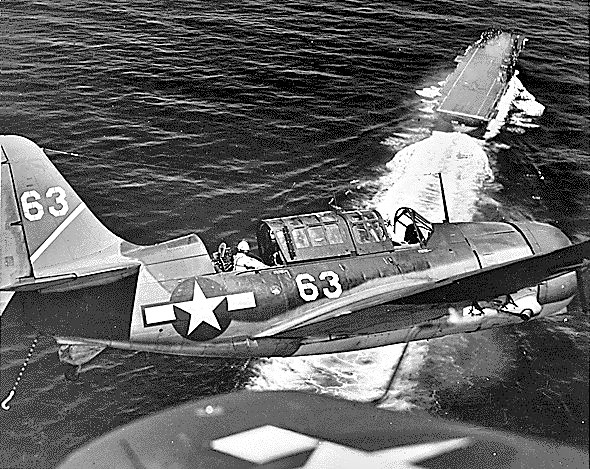
xx SB2C-1C_Helldivers_of_VB-1_fly_over_USS_Yorktown_(CV-10)in_July_1944(80-G-376123)_R-1

1 Like

Not a book but history related — today in 1453

The Fall of Constantinople occurred on May 29, 1453, after a siege that began on April 6. The battle was part of the Byzantine-Ottoman Wars (1265-1453).
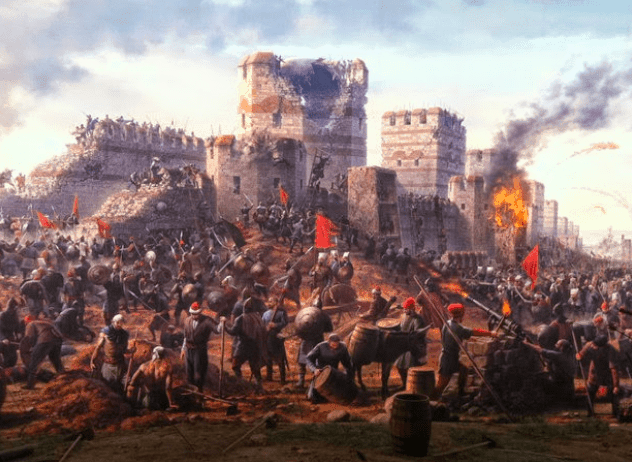
https://greekcitytimes.com/2026/05/29/may-29-1453-fall-of-constantinople-2026/

“A turning point in Western history, the Fall of Constantinople is seen as the end of the Middle Ages and the beginning of the Renaissance… The loss of Constantinople severed European trade links with Asia, leading many to seek routes east by sea and keying the Age of Exploration.”

1 Like

that set the stage for the Battle of Vienna in 1683 where my favorite person in history, john sobeiski - king of poland; turned back the muslims and saved europe. who knows what europe would be like today, or rest of the world for that matter; had the muslims won that.

I’m only 100 pages into it but I’m liking the rich details on the origins of the conflict, the persons involved on both sides of the Atlantic, and their actions — 577 pages, newly published

Funny anecdote: Chapter Four describes how 29-year old John Adams wrote a series of four seminal essays in 1765. Metaxas writes that Adams used the “presposterous nom de plume Humphrey Ploughjogger.” :laughing:

Finished 1929. Made me hate Phil Gramm even more for getting Glass-Stegall repealled.

Now on the Hamilton. Quite honestly, I had no idea how difficult he youth was. To rise as he did was remarkable and a tribute to his hard work and intellect

2 Likes

@coachv, I strongly agree with you on Glass-Steagall.

Amazing Factoid — Citigroup merged with Travelers Ins. in ’98, in violation of Glass-Steagall which wasn’t repealed until ’99:

  • (Grok) The Citicorp-Travelers merger was announced in April of 1998 and completed on October 8th of that year, creating Citigroup. This combination of commercial banking with insurance underwriting was not permitted under the Glass-Steagall Act, which remained in force until its repeal the following year. The Federal Reserve granted conditional approval, requiring divestiture of non-compliant activities within a set period if the law was not changed. The Glass-Steagall Act was repealed on November 12, 1999, when President Clinton signed the Gramm-Leach-Bliley Act into law. This effectively retroactively legalized the Citigroup merger that had already taken place in 1998.

I wish that after the ’08 crisis, we simply passed a new law that said: “The Glass-Steagall Act as it existed from 1934-1999 is hereby reinstated.”

per Grok, here’s how the repeal contributed to the '08 crisis:

  • Creation of “Too Big to Fail” Institutions: The repeal enabled massive mergers and consolidation (e.g., Citigroup’s combination of commercial banking with investment activities via Travelers/Salomon Smith Barney, JPMorgan Chase deals). This led to larger, more complex, and interconnected banks that posed greater systemic risks. When they ran into trouble, the government faced pressure to bail them out to avoid broader collapse.
  • Cultural and Incentive Shift: Critics like Joseph Stiglitz argued that merging conservative commercial banking culture with aggressive investment banking culture encouraged riskier behavior. Banks chased higher returns through leverage, proprietary trading, and complex securities (including mortgage-backed securities, or MBS). Deposit-taking institutions became exposed to Investment-banking losses.
  • Amplification of the Crisis: Larger banks could underwrite and distribute more risky securities, expanding the shadow banking system and securitization of subprime mortgages. Proponents of reinstatement (e.g., some post-crisis reformers) argue this interconnectedness worsened contagion when the housing market turned. Citigroup, for example, was heavily involved and required significant bailouts.

Similar to 1929

Shattered Sword: The Untold Story of the Battle of Midway

by Jonathan Parshall and Anthony Tully (2005)

A remarkable book that gives a very detailed look at the leadup, battle, and aftermath from the Japanese perspective — 442 dense pages.

The book corrects many myths that developed in the years immediately after the battle based on faulty information, including —

  • The “fateful five minutes” / decks packed for launch. The classic image is that U.S. dive bombers arrived just as Japanese strike aircraft (armed and fueled) were spotted on the flight decks, minutes from launching a devastating counterattack. Japanese records show the opposite: strike planes were still in the hangars, carriers were recovering or launching combat air patrol (CAP) fighters, and a full strike would have taken far longer to prepare. The single Zero seen taking off from Akagi was a CAP fighter, not the start of a mass launch. Fuchida’s dramatic version was fabricated.

  • Americans won against overwhelming odds. When Midway’s land-based aircraft are counted, the U.S. side had more planes. Japanese carriers were operating at the end of a long supply line with doctrinal and operational limitations that made the outcome less “miraculous” than popular accounts suggested.

  • Nagumo’s decision to rearm for land attack was the critical error that prevented an immediate strike. Continuous U.S. attacks, CAP cycles, and the need to recover the Midway strike already made a rapid, coordinated counterattack very difficult.

  • Hornet’s Torpedo Squadron 8 “pulled the Zeros down” so the dive bombers could attack unopposed. VT-8 attacked much earlier; later torpedo attacks and Japanese fighter-control/discipline issues were more relevant. Many Zeros would have climbed back to altitude anyway.

These revisions shift emphasis from luck and last-minute heroics toward Japanese doctrine, search methods, flight-deck/hangar operations, and command decisions.

2 Likes

I read this recently. It was a quick read, and I really enjoyed it. A series of essays by Larry McMurtry that tackle the mythology of Texas from a number of different angles.

3 Likes

thanks for this, always looking for a good WW2 book. some i read past year were, ‘last stand of tin can soldiers’ and ‘starvation island’

2 Likes

I wish Last Stand of Tin Can Sailors could he made into a movie

I just finished this one.

EVERYBODY needs to read this, and learn from it.

I had NO idea until now just how deep this was/is.

image

1 Like

Twilight of the Gods: War in the Western Pacific, 1944-1945 (The Pacific War Trilogy, 3)

by Ian W. Toll (792 pages)

I just completed Volume 3 of this amazing trilogy. The other two are reviewed above. Amazing level of insightful detail. Recommended. Here are a few of snippets:

I did not know that late in the Pacific war, after Germany had fallen, the Soviets had massed their troops in Siberia to attack Japanese-held Manchuria.

• Japan had been negotiating with Russia, hoping to make peace with the Allies through them. Instead, Russia was planning to stab them in the back.
• After the first A-bomb was dropped the Japanese met with the Russians to talk again about a peace deal.
• Instead of peace, Russia told Japan they were declaring war with hostilities commencing tomorrow — time zone unspecified.
• Russia spans so many time zones that “tomorrow” was actually only one hour away in the Far East — and that is when Russia attacked Japanese positions, surprising and overrunning them.
• Russia’s plans included seizing Hokkaido, the northernmost large island of Japan, but the 2nd A-bomb convinced Japan to surrender before this could happen.

It took until 1946 for some troops to come home from the Pacific.

Grok —
• The Pacific phase of Operation Magic Carpet continued until September 1946. The final contingent of roughly one hundred twenty-seven thousand three hundred troops from the Pacific war zone arrived home that month, with the overall operation concluding on September first.
• Most had returned by the end of 1945 or early 1946, but those stationed in more remote areas of the Pacific and the China-Burma-India theater waited longer due to limited shipping capacity.

I am 100 pages in to “Apple in China” and it’s a pretty good book.

Lots of good memories of the early Apple & IBM PC era.

Thank you.

Glad you like it!

I enjoyed it!

Finished “Apple in China” — Good story. I had no idea how difficult and cutthroat the PC/cell phone businesses were/are. Especially Apple always trying to be on the leading edge with technology.

Below is a tweet from the author sharing someone else’s photos of Foxconn’s Terry Gou at Tim Cook’s retirement. Cook’s last day was yesterday.

https://x.com/PatrickMcGee_/status/2094558440429584730

Interesting!

Thanks!