Oil prices are up because we’re about to attack Iran. This will only help EV transition.
The thing is, our entire transportation apparatus (cars, roads, energy, manufacturing) is all on a streamlined, always-reliable source of energy.
If EVs were able to reach ICE vehicle ranges consistently even just technologically, the cost of these particular vehicles are going to be astronomical.
Also, EVs and ICE vehicles are not equivalent.
For example, an ICE Toyota RAV4 XLE would not be the same price as an EV Toyota RAV4 XLE.
Therefore, it will be an interesting experiment to see if people are willing to sacrifice luxury for base model EVs.
There has to be an incentive, and based on sales reports, climate change is clearly not an incentive for people to buy EVs at the moment.
In this case, with a technological advance as I suggested, the pricing model could also change.
Not equivalent? You mean not equivalent in price currently? We are talking about some uspecified time in the future, and after some major technological leap. It is entirely possible, even if unlikely based on what we currently know, that the costs and pricing model would be very different in this unspecified time in the future.
Plus it wouldn’t happen in a vaccum, there’s no guarantee we won’t have some issue in the market (be it war, natural disaster, etc) that affects the price of gas changing the economics of this all.
What I’m saying is you’re making definitive unqualified statements about the future claiming that certain things could never happen. I say that’s bunk. It couldn’t happen with today’s technology? Sure. It couldn’t happen without a technological or economic change? Sure. It couldn’t happen without tax incentives? Sure. But to say that this could never happen period is ridiculous.
Of course, just like a 4 cylinder Mustang is not the same price as the V-8.
1 Like
Don’t know but maybe this was asked earlier in the thread, either way, it is a good question.
One thing to consider is that only about 30% of car sales are new cars. That slows down conversion. Especially true as used EVs still are not as highly thought of. Plus with battery degradation after 100,000 miles becomes an issue that is not as relevant with ICE vehicles. More so when considering engines can easily last 300,00 miles and cost $5000 to replace while a battery only last 100-200,000 miles and cost up to $20,000 to replace.
Next step is realizing the average person is buying what meets their needs, not what is politically correct. EVs do not do that for most people with the limited charging capabilities. I do not think range is the biggest issue.
So wait until used ICE vehicles are gone and people have to change their lifestyle habits or build a system where the EV does not alter lifestyle. Then the country can convert over in mass.
That’s not a equivalent
You’re talking engines, both of which are ICE
I’m talking about cosmetic of the same exact model but as an EV
It is equivalent. I know what you’re talking about. It’s a different engine option. BMW does it now.
1 Like
Damn, do you pee in a cup while you drive?
Kidding. I’m waiting for longer ranges, and shorter charging times, for EVs too. Currently own a hybrid Escape and it loves Houston’s crappy traffic. I regularly get more than 600 miles on its 14.3 gallon tank driving in town. Long highway trips I get less of course
To be clear, that’s just the standard hybrid model and not the plug-in hybrid
version ?
Always interested in real world numbers; 42 mpg is pretty good.
Yes, the standard hybrid and not the plugin.
Now, when I say regularly I do mean it but also I like to push it and won’t fill up until it says I’m at least 10-20 miles till empty. My record is 621 with about 6-7 miles to go (supposedly).
This tank I might get 640-50 if I push it. Traffic has sucked and its killing it(in the good way).
And yes, 42 is kinda cool . Especially, considering what my F150, that I used to drive All the time gets.
Funny though, when I manually calculate my MPG it it’s normally 41-42 or so. But the dash boards auto calculator for MPG always says I get more like 44-45. Then when I fill up and manually calculate it the truth comes out. Wonder what bad math they’re using to get the always higher numbers?
As your truck ages, don’t go so low without refilling.can cause filter issues. Saw this today
In 2023, at the Cybertruck Delivery Event, Tesla said that they would launch a RWD Cybertruck with a 250 mile range for $61k
Today, they launched an AWD Cybertruck for $60k with 325 miles of range, 4.1s 0-60, outlets and tonneau for even less than they said the RWD would be.
Cheaper, more range, AWD, and quicker. Count inflation and the current new AWD price near matches the ones shown in 2019 too.
I think that pricing is probably literally supply and demand working itself out in the market. Time will tell but I think it will go lower.
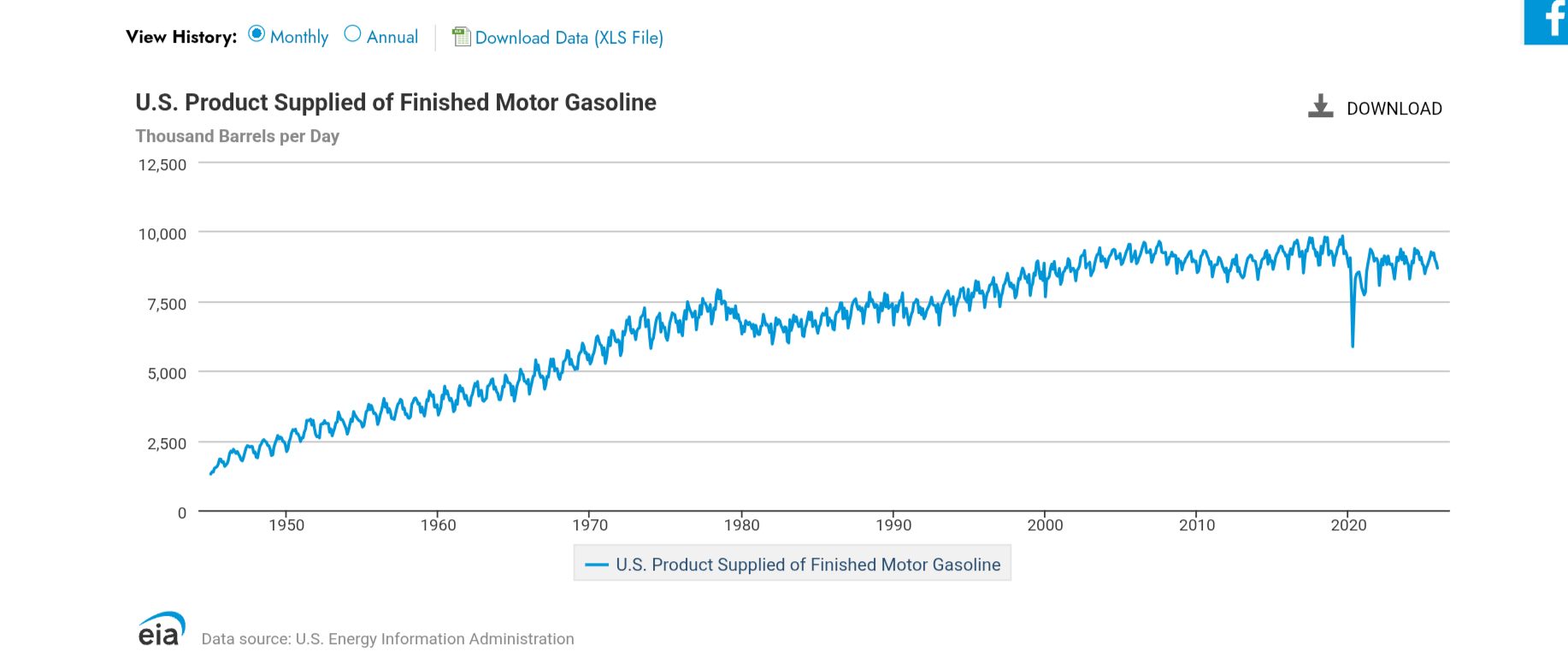
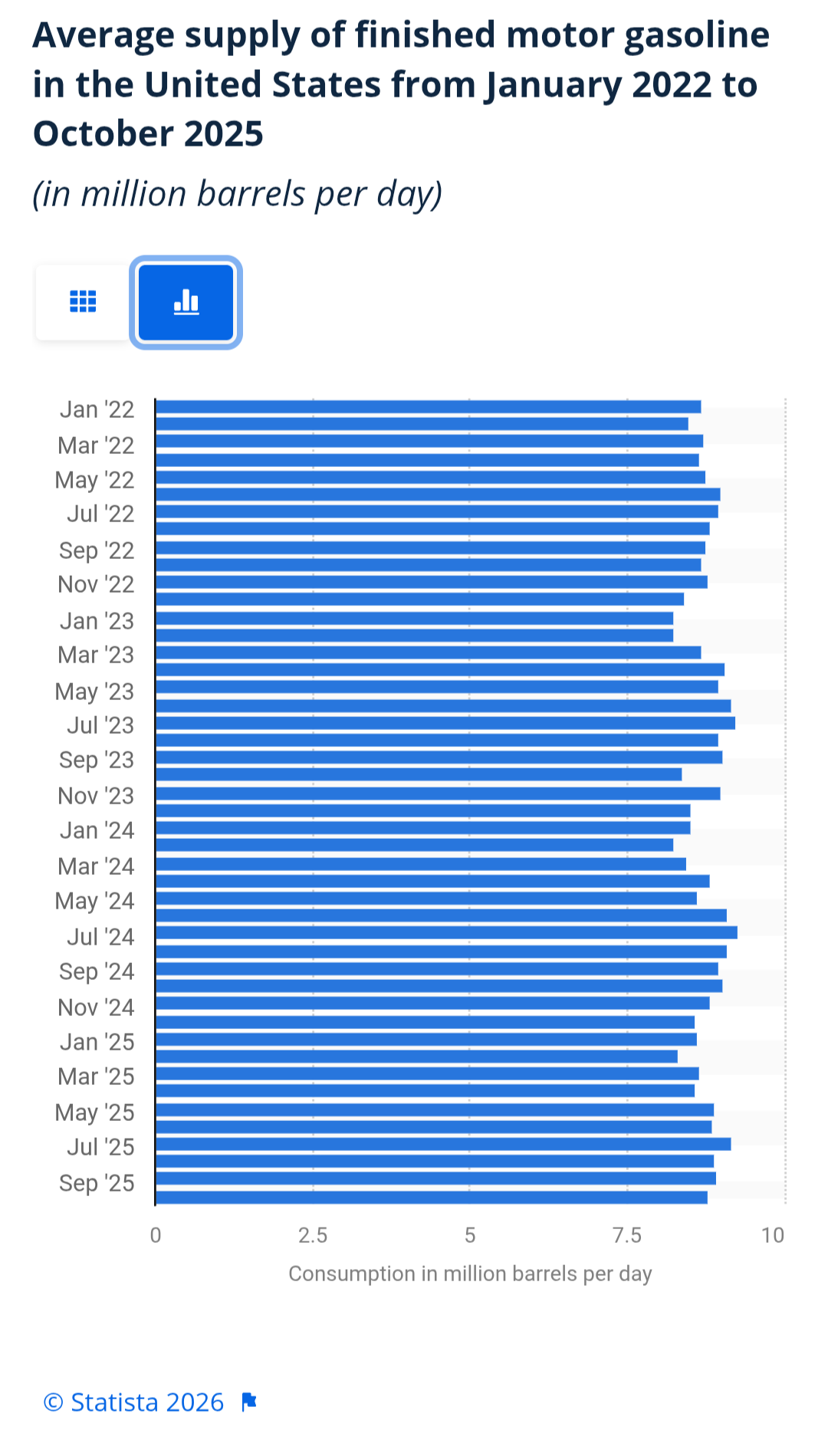
Getting back to the original reason for this thread, it does look like evs and hybrids have stopped the increase in fuel consumption (at a minimum).
That’s a big price drop and it’s the supply/demand curve at work.
The 250 mile range would be a killer if you actually used it as a truck.
That would be about an 85 mile range pulling a trailer. But with that price point it may find some urban “grocery store driver cowboys” that want a truck.
Should be fun to watch if future sales increase.
I hate to go off on a tangent, but that’s sort of the way I feel about student loan forgiveness.
Just sayin’!
That said.
My car is paid off, and I have no desire whatsoever to drop any money on a Tesla, so I feel your pain!
Yes that data would support that conclusion. And being that the US population
has increased over that time period it’s good to see. Wonder what the US per capita gasoline usage would look like.
Related, look how the Norway curve has gone. Wish that was us.
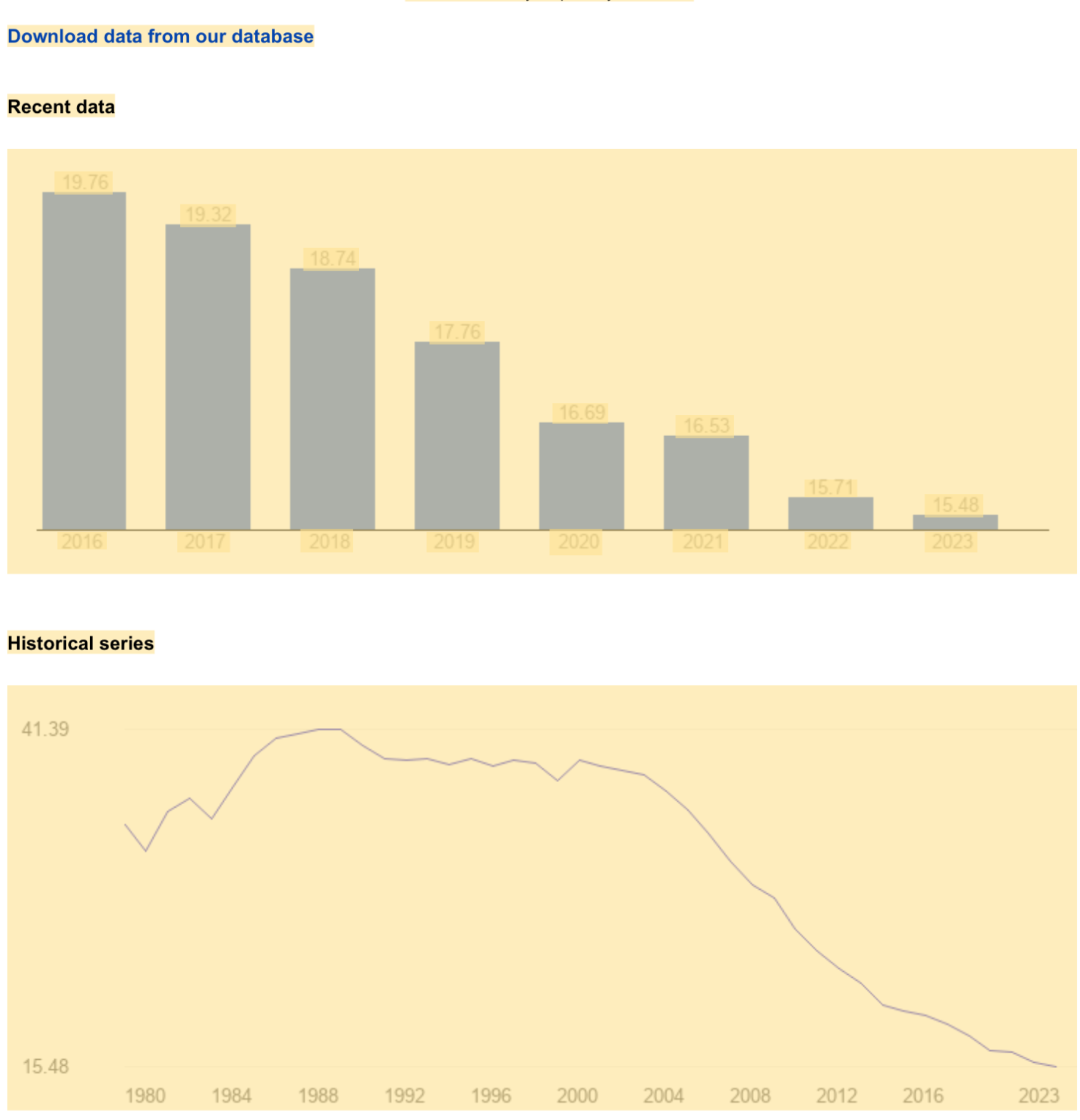
Norway Gasoline consumption - data, chart | TheGlobalEconomy.com.
1 Like
Here’s the thing about electric cars though.
Ya still gotta charge them up.
And in this country, fossil fuels like coal still provide a big chunk of the electricity that would charge up such cars.
Still puts out greenhouse gases.
It’s mostly natural gas which burns cleaner. And there is a path to more renewable in future.
EVs aren’t perfect by any stretch with regard to lowering emissions. But you don’t want to make perfect the enemy of good.
2 Likes
A big chunk of US electricity still comes from
coal though.
About 60% comes from fossil fuels of one kind or another.
It is what it is.
EVs make more sense in countries that primarily rely on nuclear (France) or geothermal (Iceland) energy for power generation.
Less overall benefit here.
See in Norway, EVs make perfect sense because only 1-2% of their electricity comes from fossil fuels.
Most (98+%) is from hydroelectric or wind power.
USA ain’t Norway in that regard, which is why it isn’t as realistic for the USA to give up ICE in the same way.
Musk recently stated solar could provide 100% of US energy needs. Tesla is ramping up solar. That’s Musk’s current position. AI Summary for you-
- “Solar is Everything”: Musk argued in 2026 that solar is the foundation of all future energy systems, calling other sources negligible.
- The “Caveman” Analogy: He frequently states that compared to the sun, all other energy sources are like “a caveman burning some twigs”.
- Mathematics of Solar: He claims only a small, specific portion of land in the U.S. (e.g., in Nevada or Texas) is needed to power the entire country, provided there is adequate battery storage.
- Sustainability: He views solar as the most sustainable, clean, and renewable way to meet long-term global demand.
- Total Energy Shift: Musk believes that the future of energy is fully sustainable, with solar being the dominant source for civilization.