Zero! I have free nights with Direct Energy
3 Likes
Well damn, that’s too easy of a calculation.
What if you go for a full home charge during the day ? About $25 or closer
to $15 or $20 ?
Not sure but I’m guessing between $5-10.
2 Likes
What is your point?
Lack of info makes this of little use.
A low cost EV, which has been the recent discussion, would be a car format. Why compare price to fill a truck or SUV? You are using Iran inflated pricing to make a point and that will not last. Gas was a $1 cheaper just two months ago and will go down again. It takes me $25 to fill my tank prior to this artificial jump, and I filled today for $35 (I also use premium).
Gas prices jump on news issues in the middle east, and electricity prices will jump on weather news and shortages in the US. How much did electricity prices jump during the winter storm the other year? Remember that at a charging station they can change prices daily. It is not a home use contract.
Compare apples to apples. ideally miles to miles would be more appropriate.
Now home chargers will save money, but that was not the discussion I was having as we were talking about infrastructure for all people.
But that’s the thing with EVs, homeowners will
most likely charge at home. ICE vehicles can’t, so you need the 165-175,000 gas stations nationwide . If we are at 65,000 public charging stations now, that’s probably the right mix for the numbers of EVs we have.
OTOH, an Ioniq 5 at $35k base, is probably in
the affordable range of apartment dwellers, but lack of recharging at their complex could be a deal breaker.
I think the point is you could probably get
level 1 charging available at most apartment complexes without a huge private investment.
Mine’s somewhere between $10-$15 a charge at home
1 Like
Unfortunately, just making up random possible things that could happen, does not contribute to an intelligent discussion. There are also power lines running along most highways, but does not mean I can just pull over and charge up. At this point apts are not installing chargers in any useful numbers. I have looked at several of the new constructions and the same thing. They are not putting them in.
65,00 probably is good for what we have now with just homeowners buying them and only needing to charge on road trips. The problem is that we are talking about growth of EVs not status quo, and without plans for growth of infrastructure, then there is a wall for how many will be on the roads. Urban growth especially, which is where it would make the most difference noting the comments about air pollution earlier in the thread. Urban is also more multi-unit homes and the need for charging locations.
ioniq 5 is definitely in the price range for many, but yes the lack of charging is the problem.
The point is that you can put a charging station just about anywhere electricity is available, do you not get that simple point, or are you too brainwashed?
1 Like
Again a stupid response. People and businesses are NOT just putting them in which is the problem. I cannot just go and install a charging station at my apartment as I DO NOT OWN THE PROPERTY and they will not just let me put one in.
Just because something is possible does not mean it is happening.
When you try to go on about “brainwashing”, it just goes to show you cannot make a valid point in the discussion or that you do not know the points being made.
Brainwashed.
2 Likes
Ok, I’ve got 5 minutes to play your game. What do you think I am brainwashed about?
Brainwashed.
1 Like
You were trying to say he had a valid point?
Here you go …
Yes, apartment buildings in the U.S. are increasingly installing EV charging stations to attract tenants and add property value
While adoption is rising due to tenant demand and “right-to-charge” laws in states like California and New York
And as I said…
Some apartment complexes now offer EV charging as an amenity for tenants, making it easier for residents to charge their vehicles at home. For example, a renter could plug in a Level 1 portable charger overnight using a standard outlet.Oct 22, 2025
1 Like
A little more on right to charge laws…
Right-to-charge laws (also known as “electric vehicle charging station policies” or “right-to-plug-in” laws) are state-level policies that remove barriers for residents in condos, apartments, orHOA-managed communities to install electric vehicle (EV) charging stations
. They prevent HOAs and landlords from unreasonably restricting the installation of chargers at personal parking spaces.
[image]Plug In America +2
Usage Examples and Key Aspects:
- HOA/Condo Installation: In states like California and Colorado, homeowners can install a level 1 or level 2 charger in their designated parking spot, even if the HOA holds, with reasonable restrictions.
- Renter Protection: Some jurisdictions, such as Washington D.C., allow renters to install chargers at their own expense in assigned parking areas, provided they meet safety and structural requirements.
- New Building Mandates: Illinois passed legislation requiring all new multiunit dwellings to have installed conduit and capacity for 100% of parking spaces to be “EV ready”.
- Permitted Restrictions: While they cannot ban charging, associations may still require the owner to pay for the installation, use licensed contractors,
1 Like
2 Likes
edit - sorry for the long post, this is more than I prefer to type.
Both good posts. I like the laws that provide a right to charge type, but to take this back to my original point and some practical thoughts.
My original point - the govt needs to support infrastructure instead of paying the top 15%ers to help EV growth. (As to theMandells earlier post - how many early adopters got paid to adopt new technology by the govt? I honestly do not know the answer, but guessing low to none)
Here we have the renters ability to pay for the new charging station which really benefits the apartment. Why not put a tax break on that part? Plus a level 1 charger only is only good for about 40 miles per 8 hour charge according to the copilot returns (ie. level 1 is 2-5 miles per hour charged). Are people really going to spend a $1000 to charge an EV then have to do it again every time they move. That makes gas the cheaper option. Plus how does it work with installing a meter to match your apartment for electricity usage (higher installation charge). Doubt the complex is going to happily absorb the charging cost.
I like that laws are requiring new parking in Illinois to have electrical foundations put in. That is a great start.
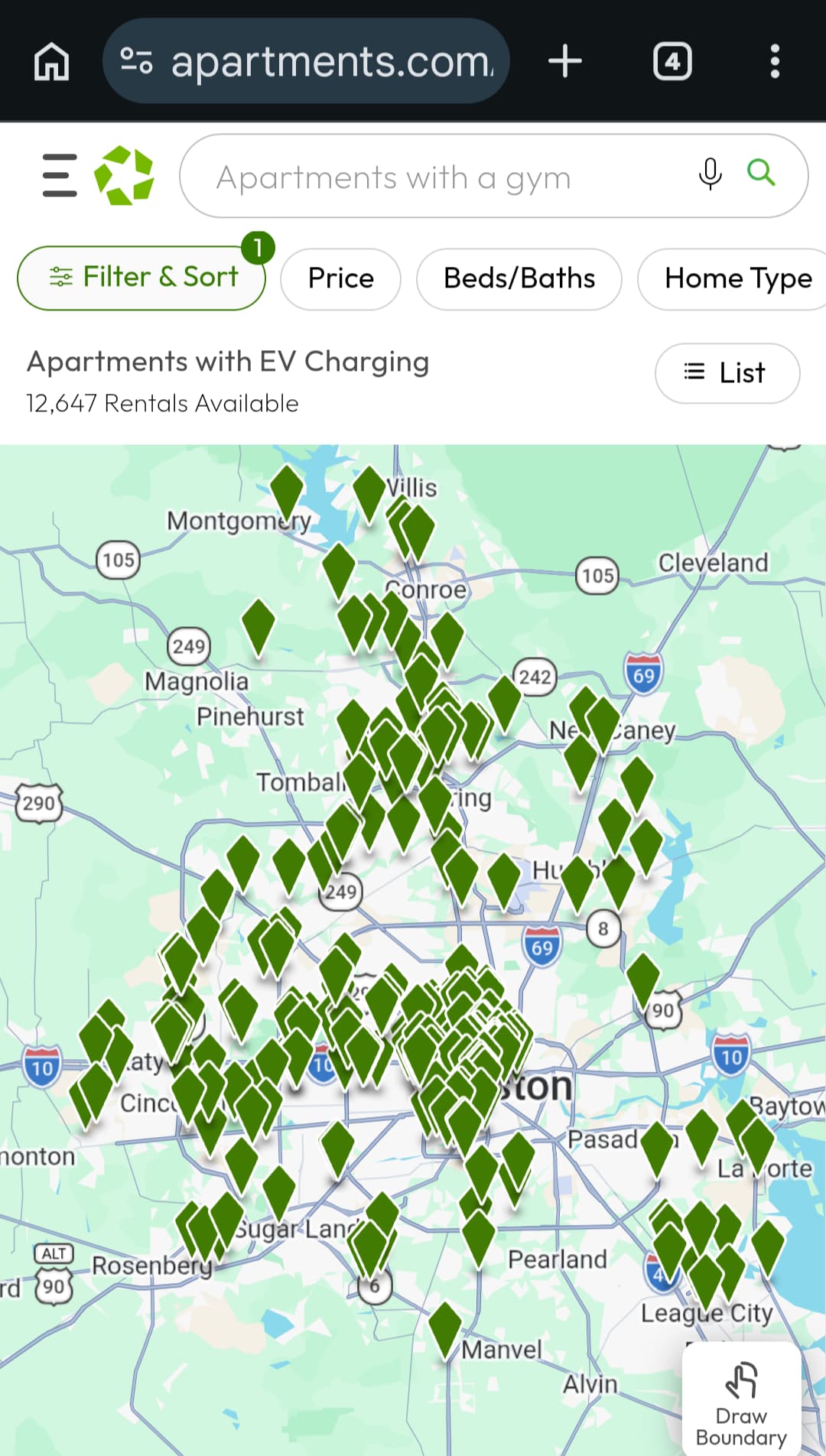
The map of properties with charging stations is good. How many have useful numbers vs just 2-4?. My experience of looking around means they might have 2-4 charging stations only. If I have 10 neighbors with EVs, what are my chances of getting my car charged every night? This goes again to getting useful amounts of charging stations installed vs a simple marketing point for the complex. Heck, people still don’t get their clothes out of a drier in a timely fashion still, hate to see them block off the chargers.
There are many things that can be done to speed the EV adoption process that are not being done because people wanted to pay tax rebates to the people that are mostly in the top 15% instead of helping by spending money to help more average income people.
Not hard to get a good infrastructure, just passing the expense to renters is not going to work as that is stupid to buy a charger then move out in a year. Why not tax breaks to the apartments to help install a useful number of chargers?
The average person just wants to be able to get from point A to point B reliably without having to think about making plans for charging or doing research on if they can charge for every trip. It just needs to simply work for the average person to switch. It does not matter if home (house or apartment) charging or just becomes habit to plug in at a store or work, just can’t be hard or extra effort.
China had a plan to install millions of chargers and it works, the US has no plan other than telling multi-unit places they have to allow charging if the renter pays for it. Big difference.