It goes way deeper than that. It’s less about having someone to leech off and more about the idea that the parent/child relationship sort of naturally flips as a parent enters old age. Multi-generational households were the norm across basically all of recorded history, and part of that is children caring for parents as they become elderly and infirm.
5 Likes
Elderly, of course…but if the parent is 50…60?
idk, my parents barely made it to 60. Not everyone is Jimmy Carter out here.
My mom didnt make it to 60 but i understand
Haven’t had a good experience with Nigerian Princes. Still waiting for the money to appear in my bank account…
1 Like
All cultures have good and bad things
2 Likes
One of the riches cities in America is between Bellaire and WU, Southside Place. I grew up there when it was very middle class, now the 8 blocks the homes average $1 million, mostly doctors, lawyers and oil execs. River Oaks would be more, but it is spread out down Allen Parkway where the homes are much smaller.
1 Like
Yeah exactly. TAMU has almost 70K at its campus. Purdue has 52K, MSU as well; Minnesota has 55K, and OSU has 60K. All of those schools are ranked higher than UH. I don’t think the number of students is the issue.
Sorry, I think I skipped over this post and didn’t respond.
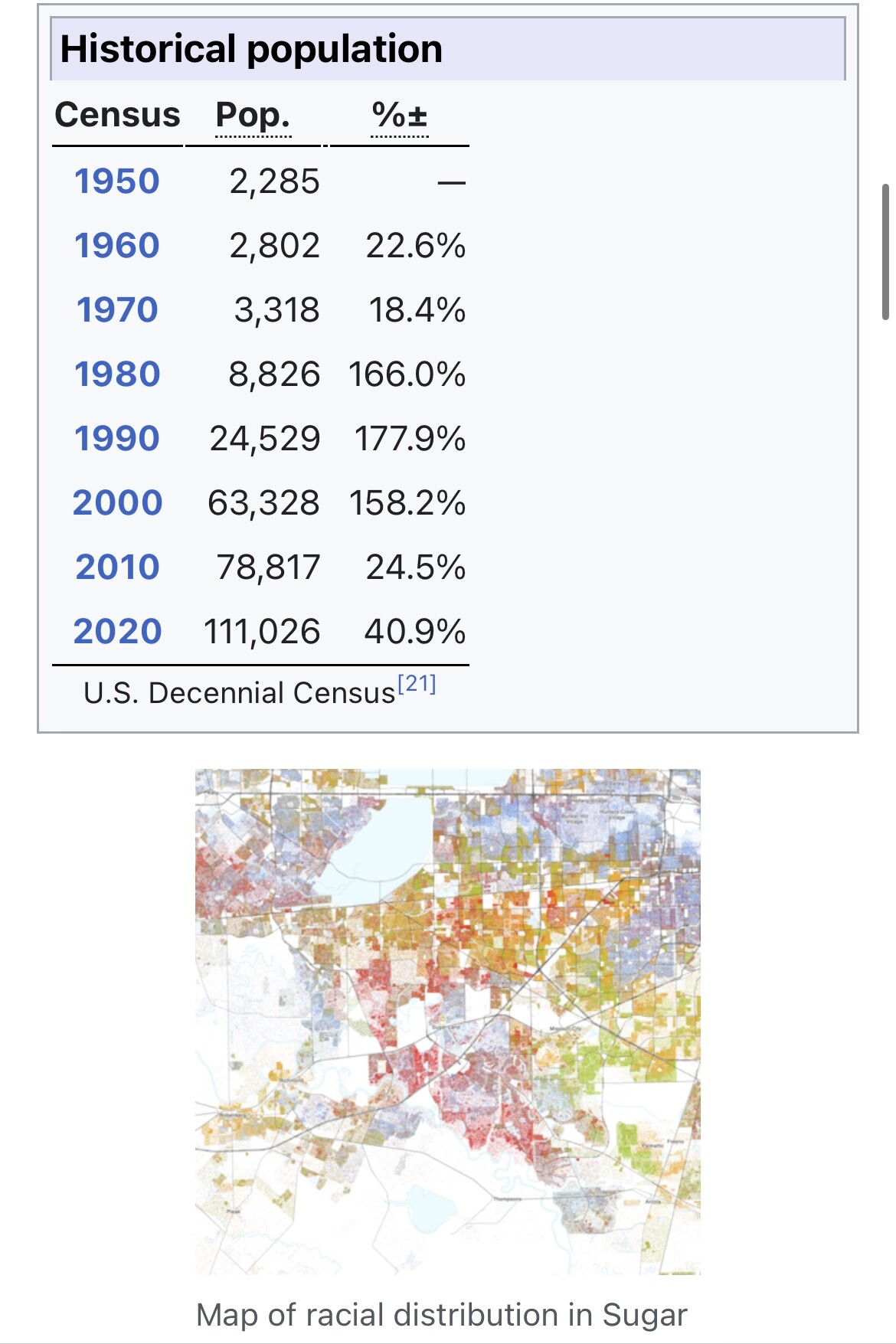
Sugarland was actually incorporated in the 60s, but the general suburban style development didn’t really blossom until the 90s, along with other similar Houston suburbia like Cypress and Katy.
The useful life of these neighborhoods won’t really show their actual costs until the 2030s. All of these suburbs are dealing with budget deficits for their school districts alone.
Oh, now its the 2030’s.
When did I ever suggest otherwise?
Also, correction. Budget cuts, not budget deficits.
That being said, I’m not saying that in the 2030s that outer suburbs will fall apart overnight. What I’m saying is that the maintenance and repairs needed will start to present themselves, and the tax base is not dense enough to pay for it all.
So instead of a consistent tax base to pay for the maintenance of both the schools and infrastructure, the first generations of the people who moved to places like Katy and early-Cypress will move places like Bridgeland and Fullshear, the newest outer suburbs, where everything is nice and shiny. Those that moved will be replaced by lower income brackets (not necessarily poor people, but by the people who couldn’t afford to move to these neighborhoods when they were first developed.
Newer residents chase “good school districts”, and “good school districts” were historically initiated by white flight which is intertwined with racial wealth gaps.
2 Likes
yes and no - same white flight area my parents bought in decades ago - same homes with basic renovations can fetch $300K - 10 miles from downtown
what people didn’t think about when it comes to Cypress, unincorporated Katy and North harris County is those areas in the county became havens for cheaper housing so those schools declined much quicker - just drive anywhere off Fry, Greenhouse, Ella, Veterans, Atascocita, etc. those “newer” starter communites aged quickly
2 Likes
Jersey Village High School is a good example of how the area is falling victim to a declining tax base.
Jersey Village boomed in the 80s, and throughout this period + the 90s, JVHS used to be a predominantly white student demographic.
In 2024, JVHS is overwhelmingly Hispanic and has a higher black student population than white, and yet, the neighborhood that the school serves is majority white.
Once the baby boomers that own those homes start to pass away over the next 10-15 years, Jersey Village is going to become even worse (based on historical patterns of school districts) because those homes will be sold to lower income brackets.
The children of the baby boomers that grew up there are either living further away for the “good schools”, or they are choosing to live in the inner loop before having children.
This cycle, is going to continue happening until it reaches the very edge. Once there’s no more room to sprawl outward, the wealthier people on the outside will start buying homes closer to the city, even if it’s in the beltway, and renovate and/or tear down/rebuild homes that were historically rough areas since the 70s/80s/90s
If Abbot’s School Voucher program passes, it’s going to completely dismantle HISD. All those HISD kids are going to be forced to move into the suburbs like Cypress, which will just speed up the process.
1 Like
Can you explain Abbott’s proposed school voucher program and what that means for inner loop residents /schools and the suburbs?
Essentially, it’s “school choice” program in theory which is supposed to give kids, including lower income kids, tax-funded assistant to attend private schools (usually religious schools).
The problem, is that these vouchers only provide a fraction of the total cost of tuition, and the private schools aren’t obligated to accept these students either. So it essentially taking money away from public districts like HISD (who is already near collapse), and puts the money into private schools that are already attended by wealthier students.
The kids who can already afford to send their kids to private schools, can apply for these tax-assisted subsidies
1 Like
JV (and Mayde Creek) seemed upper middle in the early ‘90s. People were moving to Cypress. And now to Montgomery and Conroe.
The Woodlands have kept its value.
How has the HS that was Robert E Lee past 610 and close to Memorial sustained itself? I had bosses in the 90s that lived in the Lee and JV zones.
How so…school district revenue is per the property taxes raised in that district, whether or not you have children or opt not to send them to the public school you are zoned to…school district taxes are still collected
Woodlands jumped the gun and developed an expensive master planned community very early on that targeted fairly wealthy people at its inception. Because it developed an expensive neighborhood far away from Houston, it’s been able to maintain its affluence.
I’m not sure which high school you’re referring to, but if you’re talking about Memorial Villages, as I’ve said before, the wealth in that community has likely stayed there
Pretty much throughout the west side of Houston both inner loop and inner beltway is very generationally-wealthy people
Property taxes don’t pay for 100% of the districts.
The basic allotment provides funding as well, but yes the majority, I would say about 2/3s, comes from property taxes
HISD serves a very high level of low income families.